

TAKE NOTE (Insights and Emerging Technology)
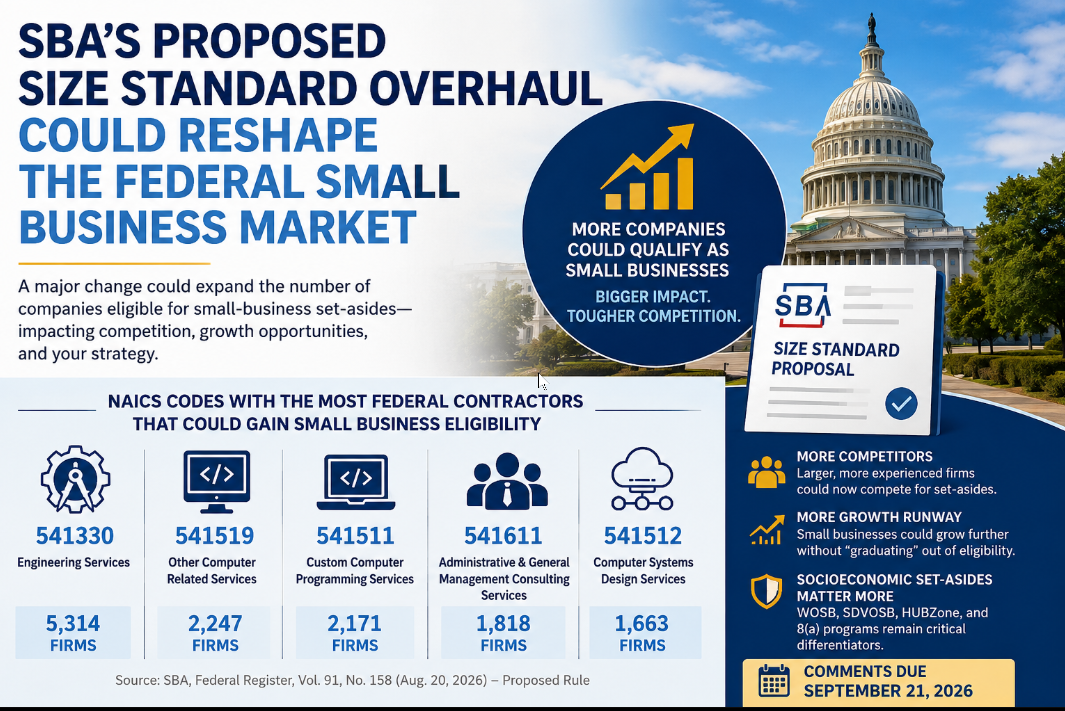
Last month, we covered SBA’s proposal to dramatically overhaul the size standards that determine which companies qualify as small businesses for federal contracting. Now there is an important new development. SBA has announced a 60-day extension of the public comment period, moving the deadline from September 21 to November 20. The agency said the additional time comes in response to requests from industry and other stakeholders seeking more time to evaluate changes that could significantly reshape the federal small-business marketplace.
The extension is significant because this is far more than a routine adjustment for inflation. SBA’s proposal would substantially increase size standards across hundreds of industries, including many heavily used in federal IT and professional services contracting. Critics argue that the increases could allow significantly larger companies to compete for opportunities currently reserved for smaller firms. Others believe higher thresholds would give successful small businesses more room to grow before having to compete directly against the largest federal contractors. SBA has already received extensive industry feedback, making the additional 60 days an opportunity for that debate to continue.
The extension does not mean SBA is backing away from the proposal, and contractors should not assume the final rule will look exactly like the proposal either. SBA could retain the proposed thresholds, moderate some of the increases, change its methodology for certain industries, or make other revisions based on the administrative record. The ultimate outcome could affect set-aside competition, teaming strategies, acquisition planning, M&A decisions, and the long-standing challenge of what happens when a successful small business becomes too large to remain small.
For contractors, the action item is clear: use the additional time to determine how the proposed standards affect the NAICS codes that drive your federal business. Model what happens to your competitive position if the changes are adopted, identify where new competitors could enter your set-aside markets, and consider submitting substantive comments before November 20 if the proposal materially affects your company. Last month the story was what SBA proposed. This month, the more important question is what SBA ultimately decides after hearing from industry.
Read original at Federal Register link below
Interested in learning more about RPA? Download our FREE White Paper on “Embracing the Future of Work”
UNDER DEVELOPMENT (Insights for Developers)
Why Python Belongs in the Modern SAP Developer’s Toolkit
Intro
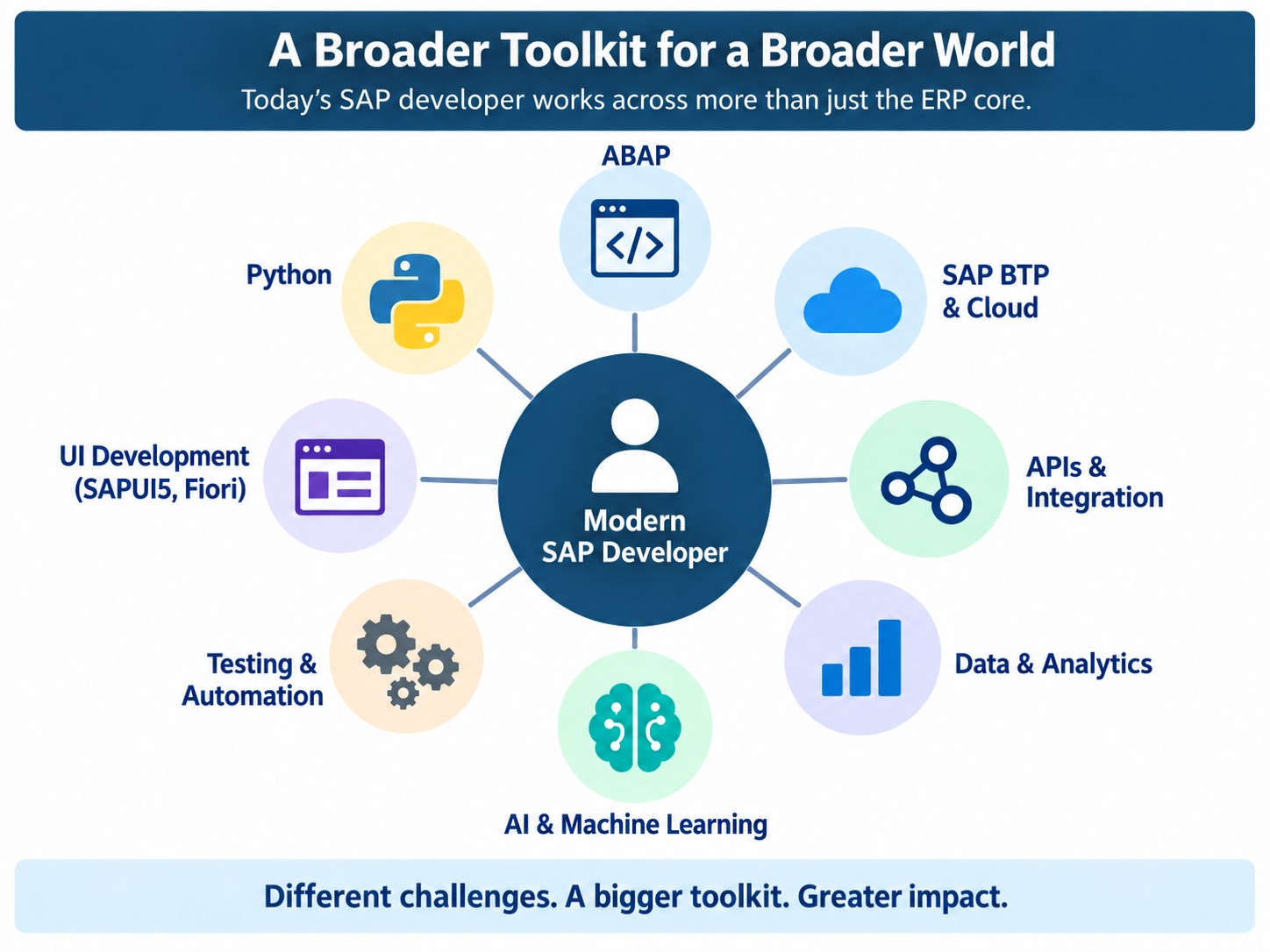
For decades, being an SAP developer usually meant becoming deeply skilled in the technologies that live inside the SAP ecosystem. ABAP was the center of gravity. JavaScript and SAPUI5 became increasingly important as the user experience moved toward web applications. More recently, SAP Business Technology Platform, cloud services, APIs, automation, and artificial intelligence have expanded the technical landscape again.
That expansion creates an important question for SAP professionals: what skills matter when the work is no longer confined to the ERP core?
Python deserves to be near the top of the list.
That does not mean Python is replacing ABAP. ABAP remains essential for many processes and extensions close to SAP business logic. Python serves a different purpose, particularly for data transformation, integration, testing, automation, migration, analytics, AI, and lightweight services.
For organizations modernizing to SAP S/4HANA, that distinction matters. The future SAP developer is part of a broader engineering environment in which SAP interacts with cloud platforms, external applications, data services, automation tools, AI models, and DevSecOps pipelines. Python provides a practical bridge into that world.strategy.

WHY PYTHON FITS THE DIRECTION OF SAP
One of the biggest changes in SAP architecture is the emphasis on keeping the ERP core cleaner and moving appropriate custom capabilities into well-governed extensions. SAP describes side-by-side extensibility on SAP Business Technology Platform as a way to build capabilities that are decoupled from the core, while on-stack extensibility remains available for requirements that need to execute inside the ERP environment.
That architectural shift changes the developer mindset. The question is no longer simply, “How do I customize SAP to do this?” Increasingly, the question becomes, “Where should this capability run, how should it integrate with SAP, and what technology is best suited to the job?” Python becomes useful because it is exceptionally strong outside the transactional core.
Consider a typical S/4HANA program. The ERP system may remain the authoritative transactional platform, but the modernization effort can also require millions of records to be profiled and reconciled, interfaces to be validated, spreadsheets and legacy extracts to be converted, test results to be analyzed, logs to be monitored, data to be prepared for AI, and external services to be orchestrated.
Python gives SAP teams an efficient way to handle those tasks without forcing every technical problem into the ERP application layer.
The first major use case is data. SAP environments contain enormous amounts of structured business information, but modernization efforts rarely involve SAP data alone. Teams may need to combine ERP data with flat files, legacy databases, data warehouses, external APIs, or cloud services.
Python has an extensive ecosystem for reading, cleaning, transforming, comparing, and analyzing data. For an SAP transformation team, this can be valuable during data migration, reconciliation, financial validation, interface testing, master-data analysis, or reporting. SAP PRESS similarly identifies data engineering, automation, integration, AI, and cloud development as areas where Python is becoming increasingly relevant to SAP professionals.
Imagine a migration team moving from ECC to S/4HANA. Instead of manually comparing large extracts before and after migration, a Python utility can identify mismatched records, calculate totals, flag duplicates, test transformation rules, and create exception reports for analysts to review.
The objective is not to replace SAP migration tools. It is to automate the analytical work around them. The same principle applies to testing. Python can call APIs, verify responses, compare expected and actual values, check file transfers, inspect interface output, and automate repetitive technical validations. Manual comparisons can become repeatable tests executed every time a build changes, which is particularly useful in regulated ERP programs where evidence and traceability matter.
PYTHON AND THE CLEAN-CORE MINDSET
The clean-core conversation is another reason SAP developers should understand Python.
Clean core does not mean “no customization.” It means being more deliberate about where extensions are built and how tightly they are coupled to the ERP platform. SAP’s guidance distinguishes between on-stack and side-by-side extensions. Side-by-side extensions can run independently on SAP BTP and communicate with SAP S/4HANA through remote APIs, while on-stack approaches remain appropriate when functionality needs to execute within the ERP environment. This creates a natural architectural boundary…
– Dig Deeper –
Learn how to use Python in the SAP ecosystem

Q&A (Post your questions and get the answers you need)

Q. What are some use cases for Python in SAP?
A. Python is increasingly useful in SAP environments, particularly for automation, data integration, analytics, and AI. It is not a replacement for ABAP, but rather a complementary technology that can extend SAP capabilities and connect SAP with other enterprise platforms.
Some common use cases include:
- Data extraction, cleansing, and transformation
- ECC-to-S/4HANA migration and data validation
- Financial reconciliation and exception analysis
- Interface and batch-job monitoring
- Automated regression and integration testing
- Master-data quality analysis
- SAP HANA analytics and forecasting
- AI and machine learning using SAP data
- Generative AI for reporting, summaries, and user assistance
- Security, access, and controls analytics
- Reporting and dashboard automation
- Integration with platforms such as ServiceNow and enterprise data platforms
Python is particularly valuable where SAP data needs to be combined with information from other systems. It can automate repetitive analysis, identify anomalies and exceptions, monitor interfaces, and support large-scale testing or reconciliation activities that would otherwise require significant manual effort.
Perhaps the fastest-growing opportunity is AI and advanced analytics. Python can use SAP data for forecasting, anomaly detection, predictive analytics, and generative AI applications while SAP remains the trusted system of record. The result is a powerful combination where SAP manages the core business transactions, while Python provides an agile layer for automation, intelligence, integration, and innovation.
Cheers!