

TAKE NOTE (Insights and Emerging Technology)

On March 17, the U.S. House of Representatives passed S. 3971, the Small Business Innovation and Economic Security Act under suspension of the rules, sending the legislation to the President’s desk for signature.
The bill represents the long-awaited reauthorization of the federal government’s flagship small-business innovation programs—the Small Business Innovation Research (SBIR) and Small Business Technology Transfer (STTR) programs—which had been operating under uncertainty following their expiration in late 2025. These programs collectively provide billions of dollars each year in research and development funding to small businesses working on emerging technologies for federal agencies
For government-contracting small businesses, the most immediate impact is stability. The legislation extends SBIR and STTR authorization through September 30, 2031, restoring the ability of federal agencies to issue new solicitations and make awards. Over the past several months, the lapse in authorization had slowed or paused many funding opportunities, leaving startups and technology-focused contractors uncertain about future R&D pipelines. With the program now reauthorized, agencies such as the Department of Defense, NASA, the Department of Energy, and the National Science Foundation can resume issuing innovation solicitations and supporting small business technology development.
The bill also introduces structural changes intended to modernize the programs and ensure that federal investments translate into operational capability. Among the most notable provisions is the creation of a “Strategic Breakthrough” funding track, allowing agencies to award significantly larger follow-on contracts, potentially reaching tens of millions of dollars—to help mature promising technologies into deployable solutions. The legislation also strengthens oversight and due-diligence requirements, particularly around foreign influence and technology transfer risks, reflecting growing national security concerns about protecting sensitive research funded through federal programs.
Another key change for the small business community is a stronger focus on program accountability and commercialization outcomes. The law encourages agencies to better track whether SBIR-funded technologies transition into production or operational use. It also calls for limits on excessive application submissions and improved data collection to ensure that awards are distributed more broadly across innovative firms rather than concentrated among a small number of frequent applicants.
For GovCon small businesses, particularly those working in areas such as AI, cybersecurity, advanced manufacturing, and defense technologies, the passage of S. 3971 represents both renewed opportunity and increased expectations. The funding pipeline for early-stage innovation is now secure for the next five years, but agencies will likely emphasize transition, scalability, and mission impact more than in previous SBIR cycles. Companies that can demonstrate a clear path from research prototype to operational capability will be best positioned to benefit from this new era of federally supported innovation
Read more at Congress.gov link below
Interested in learning more about RPA? Download our FREE White Paper on “Embracing the Future of Work”
UNDER DEVELOPMENT (Insights for Developers)
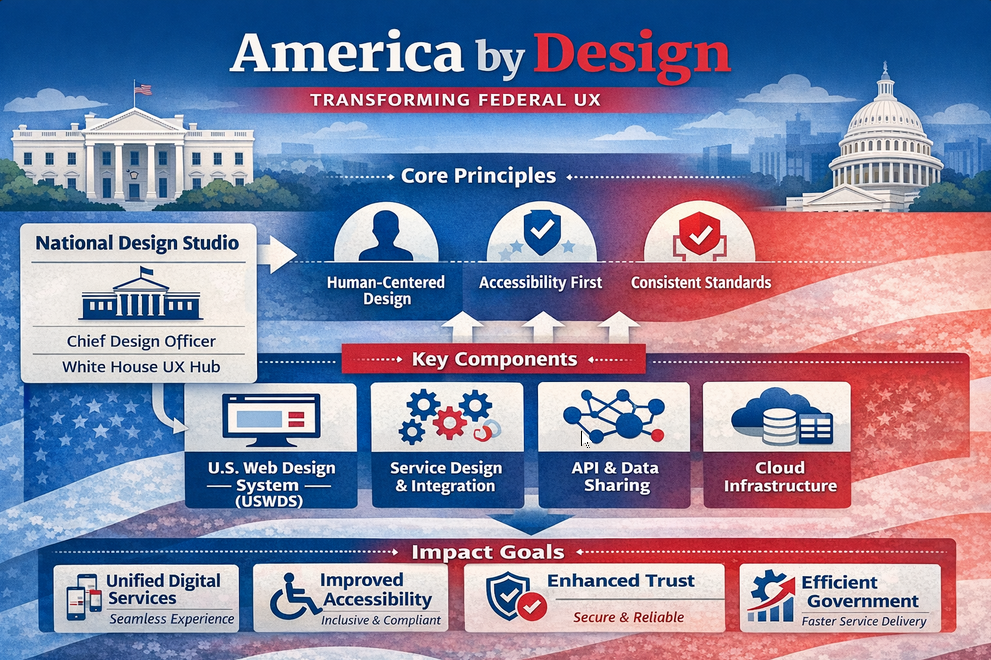
America by Design: The Federal Government’s New Standard for Digital Experience
Intro
For the past two decades, federal IT modernization has largely focused on infrastructure. Agencies migrated data centers to the cloud, strengthened cybersecurity programs, implemented identity management systems, and modernized enterprise platforms.
Today the federal government faces a different challenge. Citizens interact with government primarily through digital services, and those services often remain difficult to navigate. Many federal systems were designed around internal workflows rather than the experience of the people using them.
As a result, agencies are increasingly recognizing that improving user experience, often called UX, is not simply a design issue. It is a mission delivery issue.
The push toward federal UX modernization is now becoming a major driver of government technology spending. Initiatives such as the White House’s “America by Design” program are accelerating this shift by placing digital experience at the center of government service delivery.
For agencies, this transformation is about improving access to services. For the federal technology market, it signals the next wave of modernization investment.

Digital Government Is Now the Front Door
Most Americans no longer interact with government through physical offices or paper forms. Instead, they access services through websites, mobile applications, and digital portals.
These services support a wide range of critical interactions.
- Citizens apply for benefits
- Veterans access healthcare services
- Businesses submit regulatory filings
- Travelers complete passport applications
- Students manage federal financial aid
In many cases, the digital interface is the only point of interaction between citizens and government.
When those services work well, government appears efficient and responsive. When they do not, frustration increases quickly.
Many federal digital services still reflect legacy design approaches. Interfaces may be difficult to navigate, instructions unclear, and processes unnecessarily complex.
Improving the digital experience of government services has therefore become a major priority across agencies.
– Dig Deeper –
Experience Design The Next Iteration of UX

Q&A (Post your questions and get the answers you need)

Q. How do you apply experience design principles to improve usability and mission outcomes in Federal ERP environments?
A. Experience design in Federal ERP environments must go beyond interface improvements. It has to directly support mission execution, auditability, and workforce efficiency. In agencies operating complex systems like SAP-based ERPs, users are often navigating processes that were designed around system constraints rather than mission outcomes.
Our approach starts by reframing experience design as a mission-enablement activity. We map end-to-end user journeys across roles such as financial managers, logisticians, and analysts, identify friction points that slow execution or introduce errors, and prioritize improvements that reduce cycle time and increase data accuracy.
A key challenge in the federal space is that usability issues are often symptoms of deeper process fragmentation. Rather than treating experience design as a front-end exercise, we align it with business process re-engineering. This means eliminating unnecessary steps, reducing duplicate data entry, and ensuring that workflows reflect how work is actually performed in operational environments, including disconnected, high-tempo, or classified settings. The goal is not just a better interface, but a more intuitive and resilient process
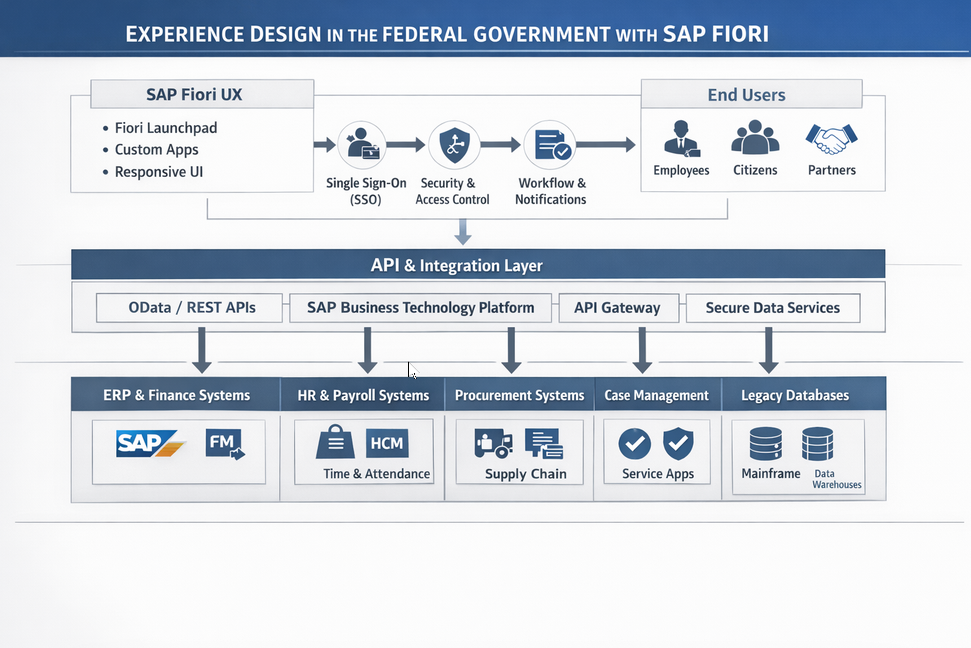
Within SAP environments, we leverage SAP Fiori as the primary experience framework to operationalize this approach. Fiori’s role-based design allows us to tailor applications to specific user personas, ensuring that individuals see only what they need to execute their responsibilities. We apply Fiori design principles such as the 1-1-3 paradigm, embedded analytics, and consistent interaction patterns to reduce cognitive load and accelerate task completion. This is particularly impactful in financial and logistics processes where speed and accuracy directly affect mission readiness and audit outcomes.
We also emphasize embedded intelligence within the user experience. Rather than requiring users to navigate separate reporting tools, we integrate real-time analytics, alerts, and decision-support capabilities directly into Fiori applications. This enables users to move from insight to action without leaving their workflow, improving both responsiveness and decision quality.
Finally, in the federal context, experience design must align with compliance and security requirements. Our implementations ensure that role-based access, segregation of duties, and audit logging are seamlessly integrated into the user experience, not layered on as afterthoughts. By doing so, we deliver solutions that are not only intuitive and efficient, but also fully compliant with federal standards.
The outcome is measurable. Reduced training time, faster transaction processing, improved data quality, and higher user adoption all contribute to more effective and accountable mission execution.
Cheers!