

TAKE NOTE (Insights and Emerging Technology)
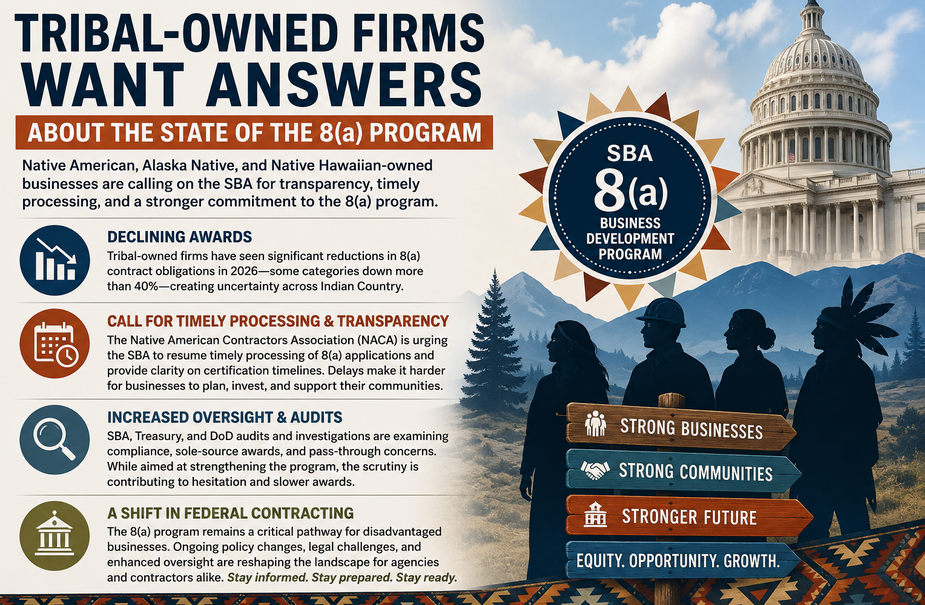
Federal contractors across Indian Country are raising concerns about the future of the SBA’s 8(a) Business Development Program as delays, audits, and declining contract obligations create growing uncertainty throughout the federal marketplace.
According to the, Native American, Alaska Native, and Native Hawaiian-owned firms have seen significant reductions in awards during 2026, with some categories experiencing declines exceeding 40%.
The Native American Contractors Association (NACA) is now publicly urging the to resume timely processing of 8(a) applications and provide greater transparency around certification timelines. Many tribal-owned enterprises rely heavily on federal contracting revenue to support healthcare, education, infrastructure, and public safety programs within their communities. Leaders warn that prolonged delays make long-term planning and investment increasingly difficult.
The concerns come amid broader federal scrutiny of the 8(a) program. Multiple audits and investigations are underway across SBA, Treasury, and DoD focused on compliance, sole-source awards, and allegations of pass-through contracting abuse. While the government says the reviews are intended to restore integrity and accountability, many legitimate small businesses fear the environment is creating hesitation across agencies and slowing awards overall.
For the GovCon community, the story reflects a larger shift underway in federal socioeconomic contracting. The 8(a) program remains one of the government’s most important tools for developing disadvantaged businesses, but policy changes, legal challenges, and increased oversight are reshaping how agencies and contractors approach the program going forward. Contractors should closely monitor developments, particularly around certification timelines, compliance enforcement, and future acquisition policy guidance
Read more at FNN link below
Interested in learning more about RPA? Download our FREE White Paper on “Embracing the Future of Work”

UNDER DEVELOPMENT (Insights for Developers)
How SAP S/4HANA Is Reshaping Supply Chain Decision-Making

Intro
There was a time when inventory management was mostly a math problem.
Companies forecasted demand, calculated safety stock levels, negotiated supplier lead times, and tried to avoid two outcomes above all others: running out of product or carrying too much of it.
If the warehouses stayed reasonably full and customers were mostly satisfied, leadership considered the operation successful.
That world is gone.
Today, inventory sits at the center of nearly every major business pressure facing the modern enterprise. Inflation changes purchasing behavior overnight. A shipping disruption on the other side of the world suddenly affects manufacturing schedules in North America. Demand spikes emerge from social media trends rather than predictable seasonal cycles. Customers expect near-immediate fulfillment, while finance departments pressure operations teams to reduce working capital exposure at the exact same time.
The problem is not simply that supply chains became more complicated. The deeper issue is that many organizations are still trying to manage modern volatility using operational models designed for a slower, more predictable era.
That is where SAP S/4HANA begins to change the story. Not because it makes reports run faster. Not because dashboards look more modern. And not because “digital transformation” has become a corporate slogan.
The real shift is much more fundamental. SAP S/4HANA changes how organizations see inventory itself.
Instead of treating inventory as a static asset sitting inside warehouses, the platform allows companies to treat inventory as a living, moving, constantly changing operational signal tied to procurement, manufacturing, logistics, finance, customer behavior, and risk. That sounds subtle on paper. Operationally, it changes almost everything.

Why Traditional ERP Environments Struggle
In traditional ERP environments, inventory planning often resembled archaeology.
Teams spent enormous amounts of time trying to understand what had already happened. Data was fragmented across warehouses, procurement systems, spreadsheets, transportation platforms, and disconnected reporting tools. By the time planners identified a trend, the business had usually already absorbed the impact.
A supplier delay became visible too late. A regional demand surge created stockouts before replenishment could react. Excess inventory quietly accumulated in the wrong locations while another facility experienced shortages.
Most organizations compensated for this uncertainty the same way: by carrying more inventory.
• More buffer stock.
• More safety stock.
• More “just in case” inventory.
It worked, at least temporarily, because excess inventory masked operational blind spots.
But carrying inventory has become dramatically more expensive. Warehousing costs continue to rise. Capital is tighter. Supply chain complexity is increasing. Executive leadership wants resilience without bloated operating costs.
The old approach no longer scales.
What SAP S/4HANA introduces is the ability to operate against live operational reality instead of delayed historical snapshots
– Dig Deeper –
SAP S/4HANA For Supply Chain Management

Q&A (Post your questions and get the answers you need)

Q. We are implementing SAP S/4HANA for Supply Chain Management, and our warehouse team is reporting inventory mismatches between SAP and our legacy system. We are also seeing duplicate material records causing MRP errors during testing.
How do companies usually fix these data and inventory problems without delaying the implementation?
A. Inventory and master data issues are one of the most common problems organizations face during SAP S/4HANA Supply Chain Management implementations. In many cases, the new SAP environment simply exposes problems that already existed in legacy systems for years. Duplicate material records, inconsistent units of measure, inaccurate inventory transactions, and outdated planning parameters often become highly visible once data is centralized inside an integrated ERP platform

One of the first things successful implementation teams do is establish a formal data governance process. This usually includes assigning business ownership for material masters, vendor records, warehouse locations, and planning data. Organizations that wait until late testing phases to clean their data often experience MRP instability, inventory discrepancies, and user frustration that can significantly delay deployment.
Companies also reduce risk by performing inventory reconciliation and cycle counts early in the project instead of waiting until go-live. Warehouse teams need confidence that the numbers inside SAP reflect operational reality. Many organizations run parallel validations between the legacy system and SAP during testing to identify transaction errors, duplicate records, and missing inventory movements before production cut-over.
Another important lesson is avoiding excessive customization to replicate every legacy process exactly as it exists today. In many cases, inconsistent inventory results are caused more by operational workarounds and manual processes than by system limitations. Organizations that adopt standardized SAP supply chain processes, combined with strong user training and hands-on testing, usually achieve better inventory accuracy, more stable planning results, and smoother long-term operations.
I hope this helps!
Cheers!