

TAKE NOTE (Insights and Emerging Technology)
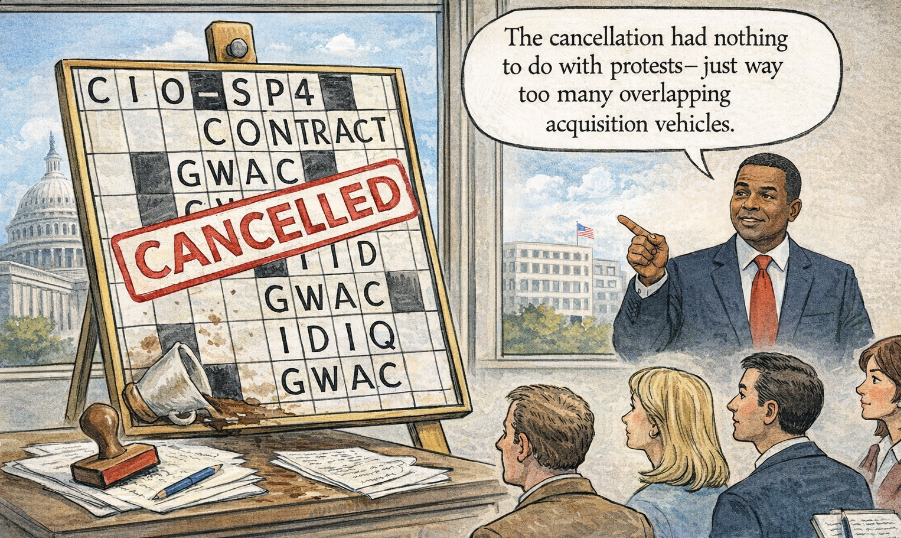
In early February 2026, the National Institutes of Health IT Acquisition and Assessment Center (NITAAC) formally cancelled the long-anticipated Chief Information Officer – Solutions and Partners 4 (CIO-SP4) Governmentwide Acquisition Contract (GWAC), closing the chapter on one of the most contentious federal IT contracts in recent memory. The suspensions, part of a sweeping compliance push tied to a broader audit of the program, underscore rising expectations for transparency and regulatory adherence among small businesses seeking set-aside and sole-source contract opportunities.
From the outset, CIO-SP4 was intended to be a successor to the highly-utilized CIO-SP3 vehicle, serving as a broad federal IT services contract with a ceiling estimated near $50 billion. However, years of delays, repeated corrective actions and hundreds of bid protests at the Government Accountability Office slowed the acquisition’s progress and forced NITAAC to repeatedly extend CIO-SP3 to ensure continuity of contract authority. Despite these obstacles, NITAAC officials maintained for much of the procurement that they were committed to seeing CIO-SP4 through to award.
In explaining the agency’s decision to cancel CIO-SP4, NITAAC Director Ricky Clark pointed to a broader federal push to consolidate overlapping acquisition vehicles and eliminate duplication across governmentwide contracts. According to the agency, many of the requirements envisioned under the CIO-SP4 scope are now sufficiently supported through existing Government Services Administration (GSA) solutions, reducing the need for an independent NITAAC-managed GWAC. This rationale aligns with recent executive guidance emphasizing procurement efficiency and stewardship of taxpayer dollars.
Contractors and industry analysts have mixed reactions to the decision. Some see the cancellation as a long-overdue recognition that complex, multi-agency vehicles must be tightly scoped and clearly manageable to avoid protracted disputes. Others caution that the protests and evaluation challenges experienced during CIO-SP4’s lifecycle reveal weaknesses in large IDIQ and GWAC structures that need addressing across the federal acquisition system.
Looking ahead, NITAAC plans to transition the existing CIO-SP3 vehicle into the GSA portfolio and extend it through at least April 2027 to bridge needs while agencies adapt to contract consolidation. For government contractors, the cancellation of CIO-SP4 serves as a reminder of the shifting landscape in federal procurement: strategic alignment with government-wide priorities, flexible acquisition portfolios and early engagement in contract design remain key to successful participation in large federal vehicle opportunities
Read more at Federal News link below
Interested in learning more about RPA? Download our FREE White Paper on “Embracing the Future of Work”
UNDER DEVELOPMENT (Insights for Developers)
The Agility Layer Modernization Without Mission Risk
Intro
Across major federal modernization programs, a new architectural pattern is gaining traction. Large initiatives such as the Army’s Enterprise Business System–Convergence effort and the Navy’s evolving ERP+ modernization landscape are increasingly prioritizing approaches that allow them to innovate quickly without destabilizing mission-critical core platforms.
You may have heard the term “agility layer” mentioned in these conversations, often described as a way to move faster while protecting systems of record. But what exactly is an agility layer, why are large enterprises investing in it, and why is it rapidly becoming a cornerstone of modern architecture strategy?
Let’s do a deep dive on what an Agility layer is…
Enterprise systems were engineered for control, consistency, and scale. They were not engineered for speed. If you have operated inside a large ERP environment, especially one that supports regulated federal missions, you understand the structural tension. Core platforms such as SAP, Oracle, or other financial and logistics systems are mission critical. They are deeply integrated, heavily customized, audited, and protected. They are also resistant to rapid change.
When business leaders want to introduce a new workflow, add mobile capability, embed analytics, or adjust policy logic, the request often collides with the realities of the core. Modifying ERP means navigating governance boards, regression testing, compliance reviews, integration risks, and expensive specialized development. Replacing ERP is even more disruptive and risky. Doing nothing leaves the organization trapped in rigid processes while the world moves faster.
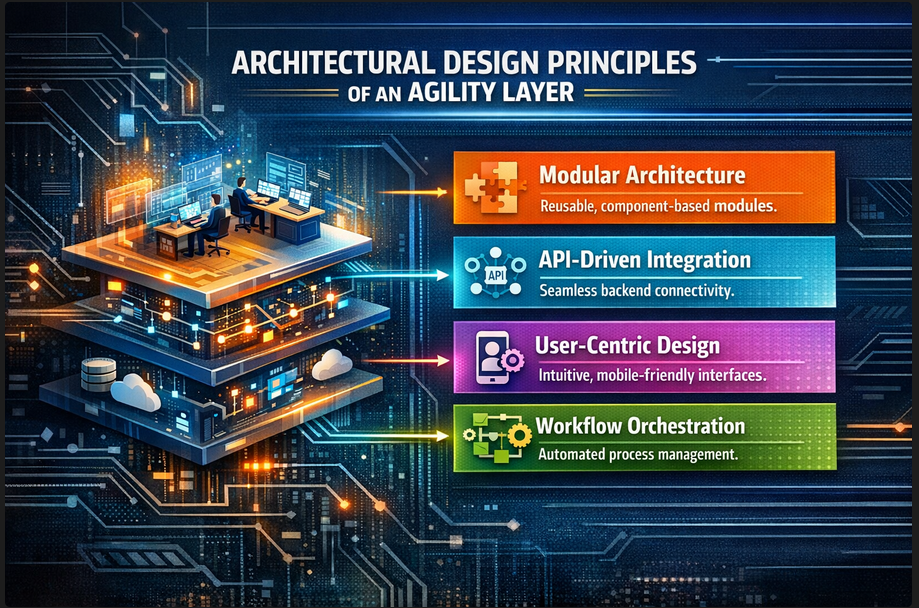
An agility layer is a modern abstraction layer placed on top of rigid legacy ERP or core systems. It enables rapid, cost effective process innovation without disrupting foundational technology. It functions as a single pane of truth that shields the core system while delivering a flexible user experience, integrated data visibility, and agile workflow orchestration. Rather than replacing the system of record, it enhances it and surrounds it with adaptable capability.
This is not a cosmetic enhancement. It is a structural architectural strategy.

Why Core Systems Resist Change
ERP systems were designed to standardize enterprise operations. They enforce financial controls, segregation of duties, audit traceability, and data consistency. Their strength lies in reliability and governance. Over time, however, many organizations layered customization after customization into the core. What began as configuration evolved into tightly coupled custom logic, integrations, and enhancements that made upgrades more complex.
Even a relatively small business change can trigger cascading technical work. A new approval threshold might require functional analysis, configuration adjustments, integration updates, security validation, and regression testing across modules. Development resources are specialized and expensive. Release cycles are lengthy. The risk of unintended consequences is high.
As a result, business units often seek alternatives. They build spreadsheet trackers. They create shadow workflows in email. They stand up disconnected applications that duplicate data. These workarounds accelerate short term progress but increase long term fragmentation and risk. Data integrity suffers, and leadership loses confidence in a unified source of truth.
The enterprise faces a dilemma. It needs innovation, but it cannot destabilize the core.
– Dig Deeper –
Clean Core: What It Is, Why to Do It, and How to Get There

Q&A (Post your questions and get the answers you need)

Q. What is a Clean Core strategy, and why does adding an Agility Layer matter?
A. Clean Core strategy is an architectural discipline that keeps mission-critical enterprise platforms, such as ERP, finance, logistics, or HR systems. Stable, standardized, and free from embedded custom code.
Instead of modifying the internal logic of the core system whenever a new requirement arises, organizations extend functionality externally using APIs, configuration frameworks, low-code tools, and side-by-side applications. This preserves vendor supportability, simplifies upgrades, strengthens cybersecurity posture, and prevents technical debt from accumulating over time. In essence, Clean Core protects the integrity of the system of record so it can reliably perform its primary function: enforcing policy, safeguarding data, and maintaining authoritative transactions.
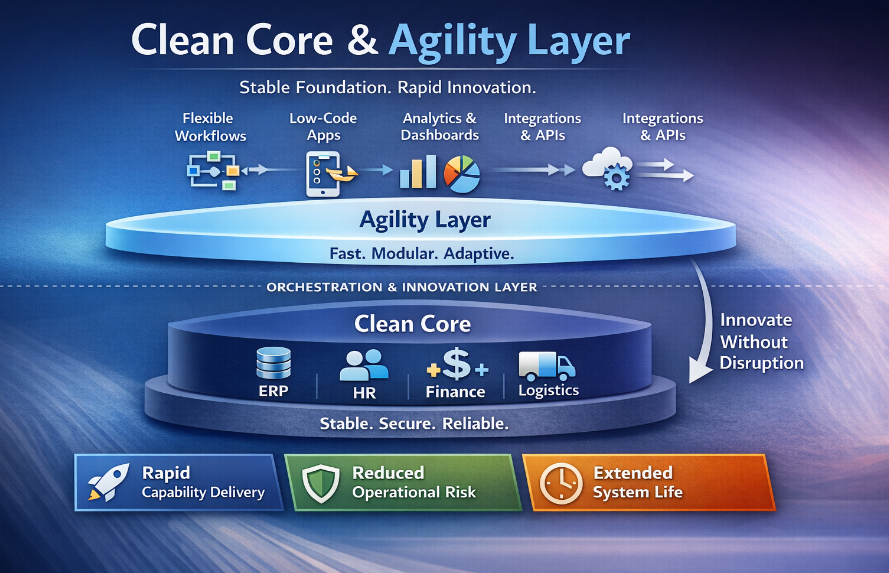
An Agility Layer is what makes that strategy operational rather than theoretical. It acts as a modern orchestration and innovation layer that sits above core systems and enables rapid change without altering them. Within this layer, organizations can design workflows, automate processes, create dashboards, integrate new technologies, and deliver improved user experiences. Because these capabilities exist outside the core, they can evolve quickly, be replaced modularly, or scaled independently and without risking disruption to mission-critical operations.
The real power comes from how the two concepts reinforce each other. Clean Core provides stability, governance, and long-term maintainability. The Agility Layer provides speed, flexibility, and innovation. Together, they separate what must remain stable from what must change quickly. This separation allows enterprises to modernize continuously instead of undergoing costly, high-risk transformation cycles every few years.
In practical terms, organizations that adopt this model gain three strategic advantages:
- Faster delivery of new capabilities without waiting for core system changes
- Lower operational risk because upgrades no longer break customization
- Longer system lifespan since the core remains clean, supportable, and future-ready
Put simply, Clean Core ensures your foundation stays strong, while the Agility Layer ensures your organization can adapt at mission speed.
Cheers!