

 Anthony Cecchini is the President and CTO of Information Technology Partners (ITP), an ERP technology consulting company headquartered now in Virginia, with offices in Herndon. ITP offers comprehensive planning, resource allocation, implementation, upgrade, and training assistance to companies. Anthony has over 25 years of experience in SAP business process analysis and SAP systems integration. ITP is a Silver Partner with SAP, as well as an Appian, Pegasystems, and UIPath Low-code and RPA Value Added Service Partner. You can reach him at [email protected].
Across major federal modernization programs, a new architectural pattern is gaining traction. Large initiatives such as the Army’s Enterprise Business System–Convergence effort and the Navy’s evolving ERP+ modernization landscape are increasingly prioritizing approaches that allow them to innovate quickly without destabilizing mission-critical core platforms.
You may have heard the term “agility layer” mentioned in these conversations, often described as a way to move faster while protecting systems of record. But what exactly is an agility layer, why are large enterprises investing in it, and why is it rapidly becoming a cornerstone of modern architecture strategy?
Let’s do a deep dive on what an Agility layer is…
Enterprise systems were engineered for control, consistency, and scale. They were not engineered for speed. If you have operated inside a large ERP environment, especially one that supports regulated federal missions, you understand the structural tension. Core platforms such as SAP, Oracle, or other financial and logistics systems are mission critical. They are deeply integrated, heavily customized, audited, and protected. They are also resistant to rapid change.
When business leaders want to introduce a new workflow, add mobile capability, embed analytics, or adjust policy logic, the request often collides with the realities of the core. Modifying ERP means navigating governance boards, regression testing, compliance reviews, integration risks, and expensive specialized development. Replacing ERP is even more disruptive and risky. Doing nothing leaves the organization trapped in rigid processes while the world moves faster.
Enter the Agility Layer concept.
An agility layer is a modern abstraction layer placed on top of rigid legacy ERP or core systems. It enables rapid, cost effective process innovation without disrupting foundational technology. It functions as a single pane of truth that shields the core system while delivering a flexible user experience, integrated data visibility, and agile workflow orchestration. Rather than replacing the system of record, it enhances it and surrounds it with adaptable capability.
This is not a cosmetic enhancement. It is a structural architectural strategy.
Why Core Systems Resist Change 
ERP systems were designed to standardize enterprise operations. They enforce financial controls, segregation of duties, audit traceability, and data consistency. Their strength lies in reliability and governance. Over time, however, many organizations layered customization after customization into the core. What began as configuration evolved into tightly coupled custom logic, integrations, and enhancements that made upgrades more complex.
Even a relatively small business change can trigger cascading technical work. A new approval threshold might require functional analysis, configuration adjustments, integration updates, security validation, and regression testing across modules. Development resources are specialized and expensive. Release cycles are lengthy. The risk of unintended consequences is high.
As a result, business units often seek alternatives. They build spreadsheet trackers. They create shadow workflows in email. They stand up disconnected applications that duplicate data. These workarounds accelerate short term progress but increase long term fragmentation and risk. Data integrity suffers, and leadership loses confidence in a unified source of truth.
The enterprise faces a dilemma. It needs innovation, but it cannot destabilize the core.
What an Agility Layer Actually Does
An agility layer sits above the system of record and absorbs change. It abstracts complexity from the user, orchestrates workflows across systems, and exposes integrated data in a unified interface. The core ERP continues to perform what it does best: maintain authoritative transactions and structured financial or operational records. The agility layer manages interaction, orchestration, and innovation.
At its foundation, the agility layer performs four essential functions. It hides technical complexity behind intuitive experiences. It allows rapid process customization through low code configuration rather than core coding. It enables new digital capabilities without modifying the ERP itself. And it unifies data from multiple systems to provide consolidated visibility.
These capabilities fundamentally change how organizations approach modernization. Instead of treating ERP as the place where all change must occur, they treat it as the stable backbone of record. Innovation happens around it, not inside it.
Abstraction of Complexity
Legacy systems often expose users to technical structure. Transaction codes, module specific screens, and deeply nested data fields require training and discipline. The system dictates the user experience. An agility layer reverses this relationship. It presents a modern interface that translates business intent into structured backend transactions.
For example, rather than requiring a user to navigate multiple ERP screens to complete a procurement action, the agility layer can present a guided form. The user provides required information in a simplified sequence. Behind the scenes, the agility layer translates that input into API calls that execute compliant ERP transactions. Required validations occur automatically. Fields irrelevant to that user’s role remain hidden.
The complexity still exists, but it is shielded. This abstraction reduces training time, lowers error rates, and improves adoption. In environments with strict audit and compliance requirements, abstraction does not weaken control. Instead, it can strengthen it by embedding business rules directly into the workflow layer before data ever reaches the core.
Rapid Process Customization
Traditional ERP customization relies on specialized development inside proprietary frameworks. Changes can be expensive and slow. An agility layer leverages low code or no code platforms to define workflows, business rules, and interfaces visually.
If a policy change requires an additional review step, the agility layer administrator can update the workflow logic through configuration rather than core modification. If approval thresholds shift, rules can be adjusted and version controlled without redeploying ERP code. This dramatically reduces cycle time.
Low code does not mean undisciplined. Governance, testing, and version management remain essential. However, the location of change shifts. The ERP remains stable while the agility layer evolves. Over time, this reduces the accumulation of risky customization inside the core.
Decoupled Innovation
One of the most strategic advantages of an agility layer is decoupling. Innovation no longer depends on modifying the system of record. Instead, new capabilities can be built in the abstraction layer.
Mobile inspection applications, executive dashboards, case management tools, and specialized compliance workflows can all operate through the agility layer. They integrate with ERP data but do not alter its structure. The system of record remains protected and stable.
This separation allows the organization to experiment and iterate. Pilot programs can be launched quickly. If a new workflow proves valuable, it can be scaled. If it fails, it can be retired without destabilizing the core.
Decoupled innovation also reduces political friction. When business units know that experimentation does not threaten ERP stability, resistance to change diminishes.
Data Aggregation and the Single Pane of Truth
Most enterprises operate across multiple systems. Financial data resides in ERP. Customer data lives in CRM. Operational metrics may exist in specialized platforms. Manual reconciliation often bridges these silos.
An agility layer can act as an aggregation and orchestration hub. Through API driven integration and event based synchronization, it can present consolidated views of data drawn from multiple authoritative sources. Users see integrated information in a single interface rather than navigating separate systems.
This does not necessarily require duplicating all data. In many cases, the agility layer queries systems in real time or synchronizes only relevant attributes. What matters is that decision makers experience a coherent view of enterprise state.
When leadership sees consistent data across workflows, trust increases. Operational decision making improves. Reconciliation overhead decreases.
Architectural Design Principles
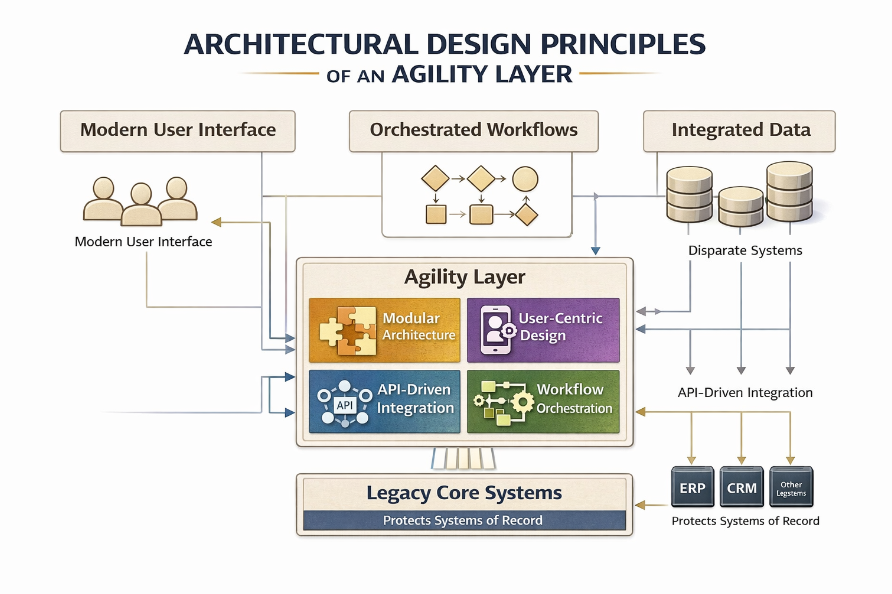
An effective agility layer is not simply another application. It must be architected intentionally. Modular design is critical. Components such as approval engines, notification services, document repositories, and integration adapters should be reusable. This prevents redundant development and supports scaling.
API driven integration is equally essential. Screen scraping or brittle automation creates long term instability. The agility layer should interact with backend systems through supported interfaces with secure authentication and traceable logging. This ensures auditability and upgrade compatibility.
User-centric design is not an afterthought. If the agility layer becomes the primary user interface for many processes, it must prioritize clarity, accessibility, and mobile responsiveness. Embedded analytics and contextual guidance can further enhance productivity.
Workflow orchestration completes the picture. The agility layer should manage routing logic, service level tracking, automated notifications, and conditional decision paths. In more advanced environments, it can incorporate robotic automation or predictive analytics without embedding that complexity inside ERP.
What Are The Benefits
The most obvious benefit of an agility layer is reduced time to market for new capabilities. However, the deeper benefits are structural.
First, it extends the life of legacy systems. ERP investments are substantial. Replacing them every time user experience expectations evolve is impractical. The agility layer modernizes the experience without forcing wholesale replacement.
Second, it enhances operational agility. When policy rules, approval flows, or data integrations can be adjusted rapidly, the organization adapts more effectively to regulatory shifts or market changes.
Third, it improves cost efficiency. Specialized ERP development is expensive and scarce. Shifting many changes into a low code abstraction layer reduces dependence on deep proprietary coding. Over time, this lowers total cost of change.
Fourth, it strengthens governance. By centralizing workflow logic and embedding controls into user facing processes, the agility layer can reduce shadow systems and increase transparency.
Speaking of Governance and Discipline
An agility layer must operate within a disciplined governance model. Without oversight, it can become another uncontrolled environment. Architecture review, integration standards, data stewardship alignment, and role based access control are essential.
Version control and release management practices should mirror enterprise standards. Audit logging must be comprehensive. Security integration with identity and access management frameworks must be seamless.
When governed effectively, the agility layer enhances compliance rather than undermines it. It becomes a controlled innovation zone instead of a workaround.
Strategic Implications for Leaders
Enterprise leaders often face what appears to be a binary choice: undertake a risky and expensive ERP replacement, or accept operational rigidity. The agility layer introduces a third option. It allows incremental modernization while protecting core investments.
This approach reduces transformation risk. It spreads change over time. It enables continuous improvement rather than episodic disruption. For organizations operating mission critical environments, that continuity matters.
The agility layer also positions the enterprise for intelligent automation. Because it already orchestrates workflows and integrates data, it becomes a natural insertion point for analytics and artificial intelligence. Predictive models, anomaly detection, and decision support tools can operate within the abstraction layer without altering ERP internals.
In this way, the agility layer becomes more than a technical pattern. It becomes the foundation for sustainable modernization.
A Measured Path Forward
Implementing an agility layer does not require a massive program launch. It can begin with a focused use case. Identify a high friction workflow that requires frequent adjustment. Design an abstraction layer interface for that process. Integrate it through secure APIs. Measure adoption and cycle time improvements.
From there, expand gradually. Reuse modular components. Standardize integration patterns. Maintain architectural discipline.
Over time, the agility layer becomes the primary innovation platform. ERP remains the system of record. The organization gains speed without sacrificing stability.
Summary
The structural tension between stability and speed is not going away. Core systems are built for control and reliability. Enterprises operate in environments that demand adaptation and responsiveness. Attempting to force ERP to serve both purposes often leads to frustration and risk.
The agility layer reconciles these competing demands. It abstracts complexity from users. It enables rapid process customization through configuration rather than code. It decouples innovation from the system of record. It aggregates data into unified views. It orchestrates workflows across the enterprise.
Most importantly, it allows organizations to innovate without breaking what already works.
For leaders seeking modernization without destabilization, the agility layer offers a disciplined, pragmatic path forward. It preserves foundational investments while unlocking continuous improvement. In an era defined by accelerating change, that balance may be the most valuable capability of all.