

 Anthony Cecchini is the President and CTO of Information Technology Partners (ITP), an ERP technology consulting company headquartered now in Virginia, with offices in Herndon. ITP offers comprehensive planning, resource allocation, implementation, upgrade, and training assistance to companies. Anthony has over 25 years of experience in SAP business process analysis and SAP systems integration. ITP is a Silver Partner with SAP, as well as an Appian, Pegasystems, and UIPath Low-code and RPA Value Added Service Partner. You can reach him at [email protected].
For years, DevSecOps has promised a better way to build software: faster delivery, stronger security, and closer collaboration between development, operations, and security teams. The vision has always been compelling. The reality has often been more complicated.
Most organizations still struggle with the same underlying problem. Engineering teams are expected to move quickly, while security teams are expected to reduce risk. As cloud environments become more distributed, pipelines become more complex, and release cycles become continuous, the pressure on both sides increases. Manual reviews cannot keep pace. Traditional security gates slow delivery. Alert fatigue grows. Backlogs expand.
This is where artificial intelligence is beginning to create measurable value, not as a replacement for DevSecOps practices, but as an accelerator for them.
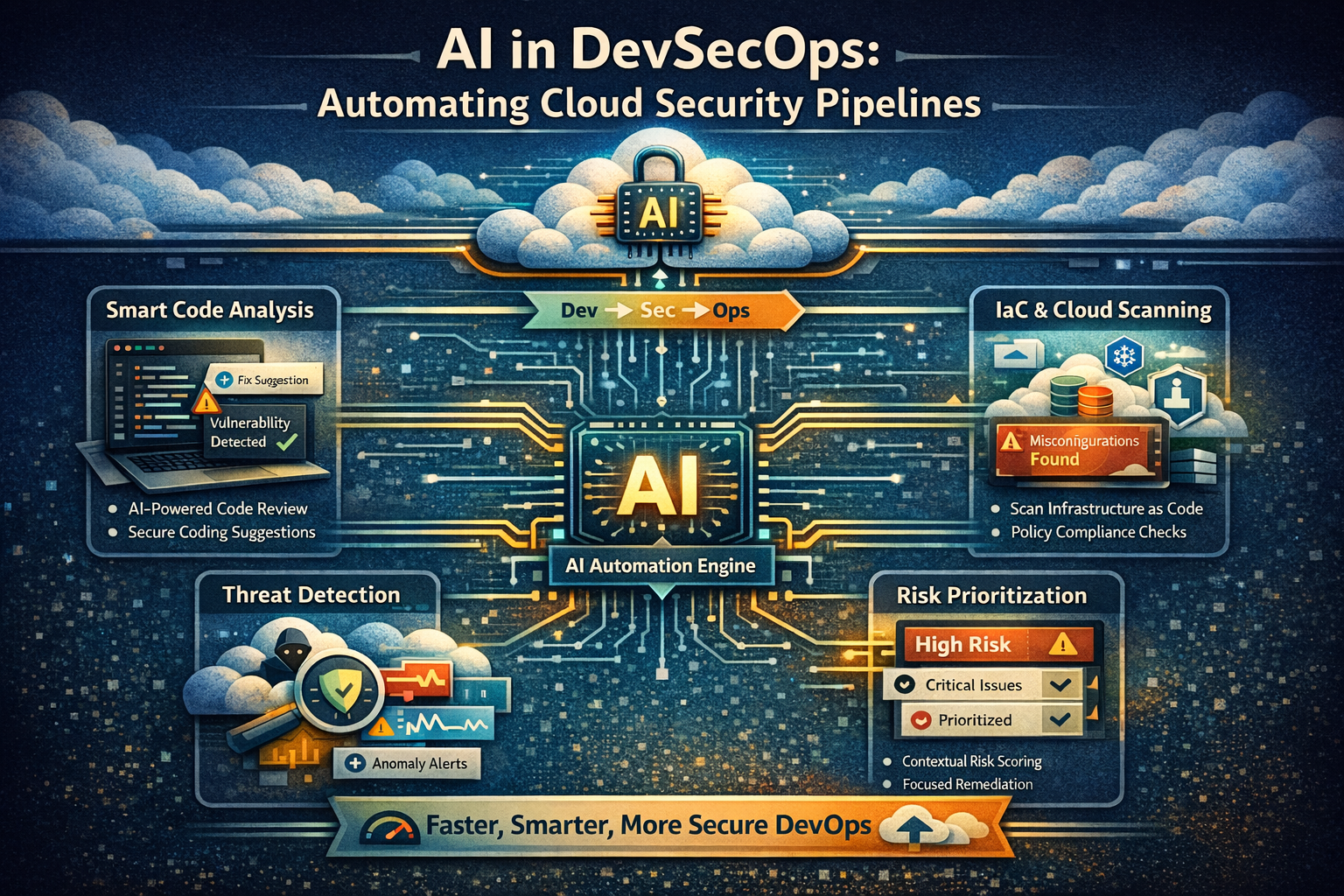 The real opportunity for AI in DevSecOps is not futuristic autonomy. It is intelligent automation that helps teams make faster, better security decisions inside the software delivery lifecycle.
Why DevSecOps Needs a New Operating Model 
Modern software pipelines now include source control, CI/CD tooling, container registries, infrastructure as code, Kubernetes clusters, cloud identity systems, third-party APIs, and SaaS integrations. Every layer introduces new risk.
At the same time, security teams are often drowning in fragmented tooling. One platform scans code. Another reviews containers. Another watches runtime behavior. Another tracks identities and privileges. Each tool generates findings, but few provide enough context for engineering teams to act quickly.
The result is predictable. Developers receive too many alerts, many of them low priority. Security teams spend time triaging noise instead of reducing meaningful risk. Leadership sees growing spend without proportional improvement.
AI has the potential to break that cycle by turning raw signals into actionable intelligence.
Where AI Is Delivering Value Today
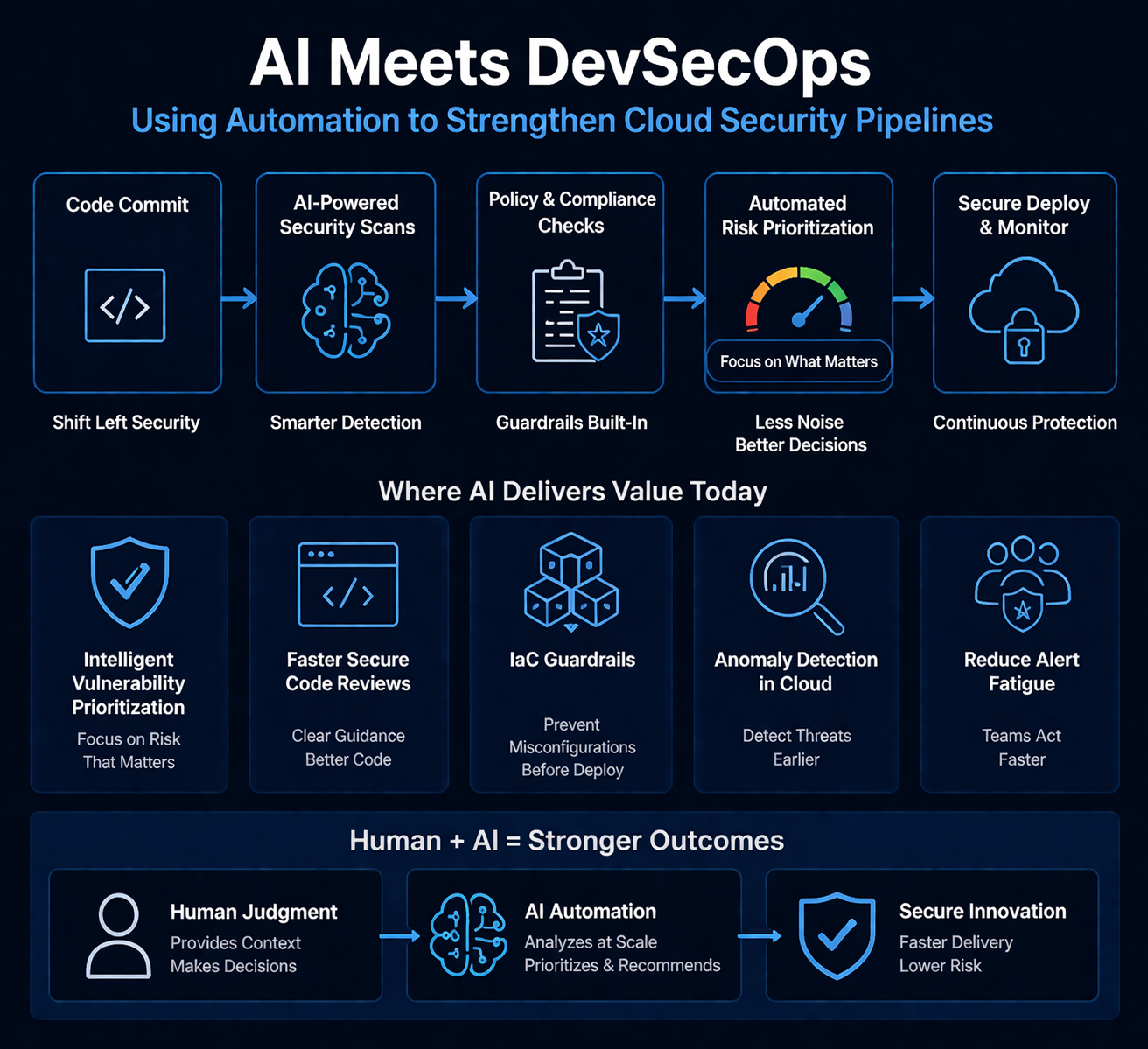 The most effective use cases are already emerging across mature engineering organizations.
Intelligent Vulnerability Prioritization
Not every vulnerability deserves the same response. Yet many teams still treat findings as flat lists.
AI can correlate exploitability, asset criticality, internet exposure, dependency paths, and historical remediation patterns to identify which issues matter now. Instead of asking teams to fix 500 items, it can highlight the five that materially reduce risk.
That shift alone can change the economics of security operations.
Faster Secure Code Reviews
Static analysis tools have existed for years, but developers often ignore results that lack clarity.
AI-enhanced tooling can explain why a pattern is risky, suggest safer alternatives, and even generate secure code fixes. This shortens the feedback loop and increases adoption because guidance arrives in the developer workflow, not in a separate security report.
Infrastructure as Code Guardrails
Misconfigured cloud resources remain one of the most common causes of security incidents.
AI can review Terraform, CloudFormation, and Kubernetes manifests for risky patterns before deployment. More importantly, it can translate policy into plain language and recommend compliant alternatives, helping teams learn while they build.
Threat Detection Across Cloud Environments
Cloud logs generate enormous volumes of data that human analysts cannot manually interpret at scale.
Machine learning models can identify anomalous identity behavior, privilege escalation patterns, suspicious east-west traffic, and unusual workload activity earlier than traditional threshold-based rules.
This is especially valuable in hybrid and multi-cloud environments where normal behavior is harder to define.
What Enterprises Often Get Wrong
Many executives hear “AI for security” and assume the answer is buying another tool.
That is usually the wrong starting point.
AI creates the most value when integrated into existing workflows, not layered on top of already fragmented environments. If teams already struggle with ticket overload, poor ownership, and unclear policies, adding AI may simply accelerate chaos.
The stronger strategy is operational first, tooling second.
Ask practical questions:
- Where does security friction delay releases today?
- Which findings are routinely ignored?
- Where do analysts spend repetitive time?
- Which controls generate noise instead of outcomes?
- What decisions need better context, faster?
Those answers reveal where automation really belongs.
The Governance Imperative
AI systems can hallucinate, misclassify issues, or reinforce poor assumptions if trained on weak data. In security, false confidence is dangerous.
That means human accountability remains essential. AI should recommend, prioritize, summarize, and automate repetitive tasks. It should not independently own high-impact security decisions without oversight.
Leading organizations are already adopting a “human-in-the-loop” model where AI increases speed, while people retain judgment.
This is the balance that matters most.
Over the next several years, DevSecOps leaders will move beyond isolated AI features and toward AI-native security operations.
That means pipelines that automatically assess deployment risk before release. Cloud environments that continuously validate least-privilege access. Security platforms that explain business impact instead of flooding dashboards with technical findings. Engineering teams that remediate issues in hours instead of weeks because the path to resolution is clear.
The organizations that benefit most will not be the ones chasing hype. They will be the ones redesigning workflows around speed, clarity, and accountability.
Summary
DevSecOps was never meant to be a collection of scanners bolted into CI/CD. It was meant to be a better operating model for secure innovation.
AI can help fulfill that promise, but only when used with discipline.
The winners in the next era of cloud security will not simply automate more. They will automate what matters, reduce friction where it counts, and enable engineers to ship securely at the pace the business demands. That is where AI meets DevSecOps in a way that actually changes outcomes.