

TAKE NOTE (Insights and Emerging Technology)

The Department of Defense is making a bold move to modernize its technology infrastructure, sending a strong message to government agencies and private organizations alike: outdated systems are no longer sustainable.
In a recent MeriTalk report, DoD Chief Information Officer Kristen Davies outlined a four-part strategy focused on transforming networks, replacing legacy technology, strengthening cybersecurity, and developing a future-ready workforce.
At the core of the initiative is the need to upgrade aging systems that slow operations, increase costs, and create security vulnerabilities. Like many large organizations, the Pentagon has faced the challenge of maintaining decades-old technology while trying to meet modern mission demands. By prioritizing network modernization and enterprise-wide efficiency, the DoD is positioning itself for faster and more agile operations.
Cybersecurity also plays a central role in the overhaul. As cyber threats continue to evolve, protecting systems can no longer be treated as a separate function. Security must be built into every layer of the environment, from infrastructure and cloud services to user access and data management. This reflects the growing importance of zero trust strategies and continuous monitoring across all sectors.
Just as important as the technology itself is the people behind it. The plan emphasizes workforce development, training, and attracting the digital talent needed to sustain transformation efforts. Successful modernization depends not only on new tools, but on empowering teams to adapt, innovate, and lead through change.
The Pentagon’s strategy offers an important lesson for every organization navigating digital transformation: modernization requires leadership, clear priorities, and long-term commitment. Those that move now will be better positioned for efficiency, resilience, and future growth.
Read more at Meritalk link below
Interested in learning more about RPA? Download our FREE White Paper on “Embracing the Future of Work”
UNDER DEVELOPMENT (Insights for Developers)
AI Meets DevSecOps
Intro
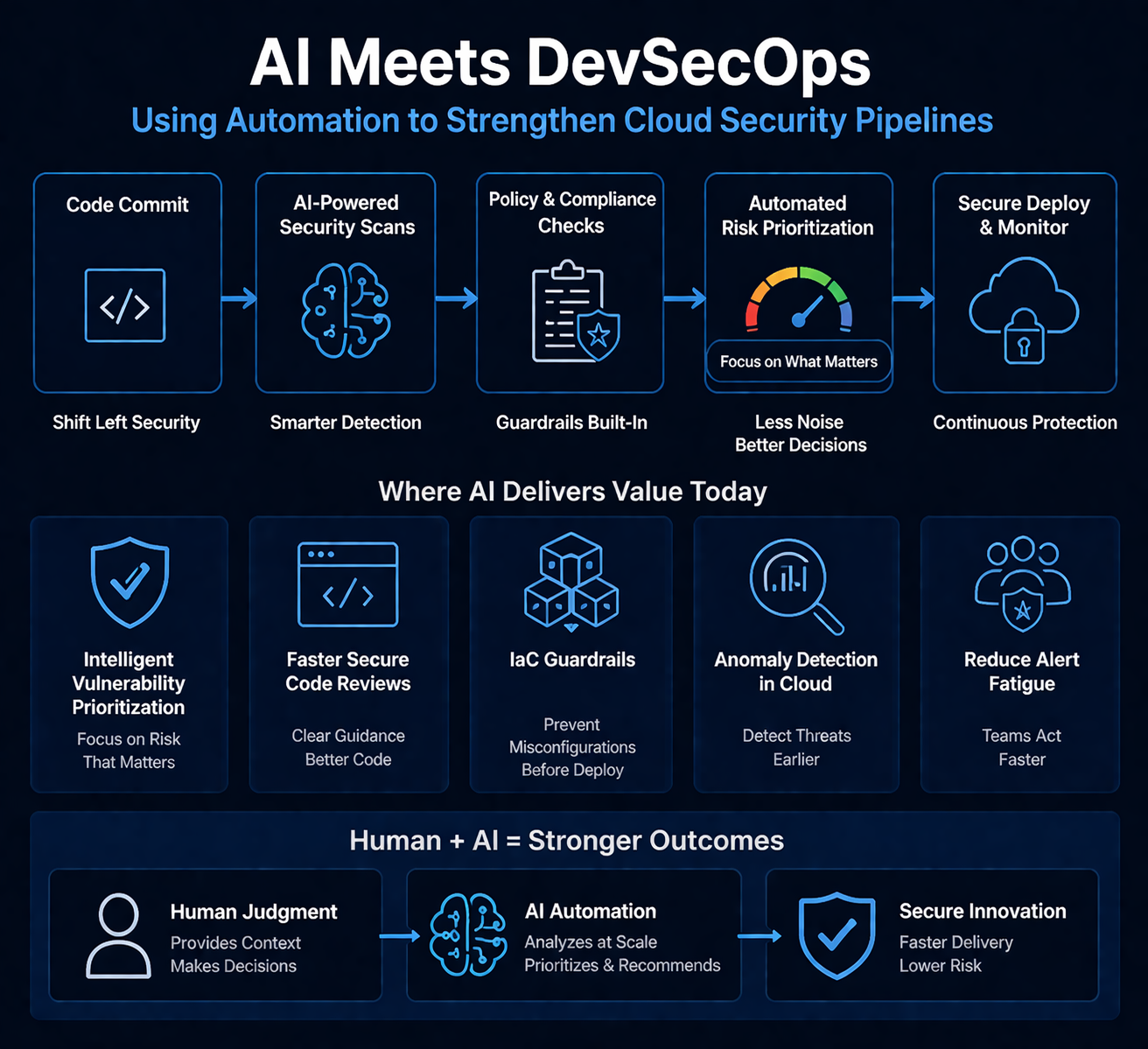
For years, DevSecOps has promised a better way to build software: faster delivery, stronger security, and closer collaboration between development, operations, and security teams. The vision has always been compelling. The reality has often been more complicated…
Most organizations still struggle with the same underlying problem. Engineering teams are expected to move quickly, while security teams are expected to reduce risk. As cloud environments become more distributed, pipelines become more complex, and release cycles become continuous, the pressure on both sides increases. Manual reviews cannot keep pace. Traditional security gates slow delivery. Alert fatigue grows. Backlogs expand.
This is where artificial intelligence is beginning to create measurable value, not as a replacement for DevSecOps practices, but as an accelerator for them.
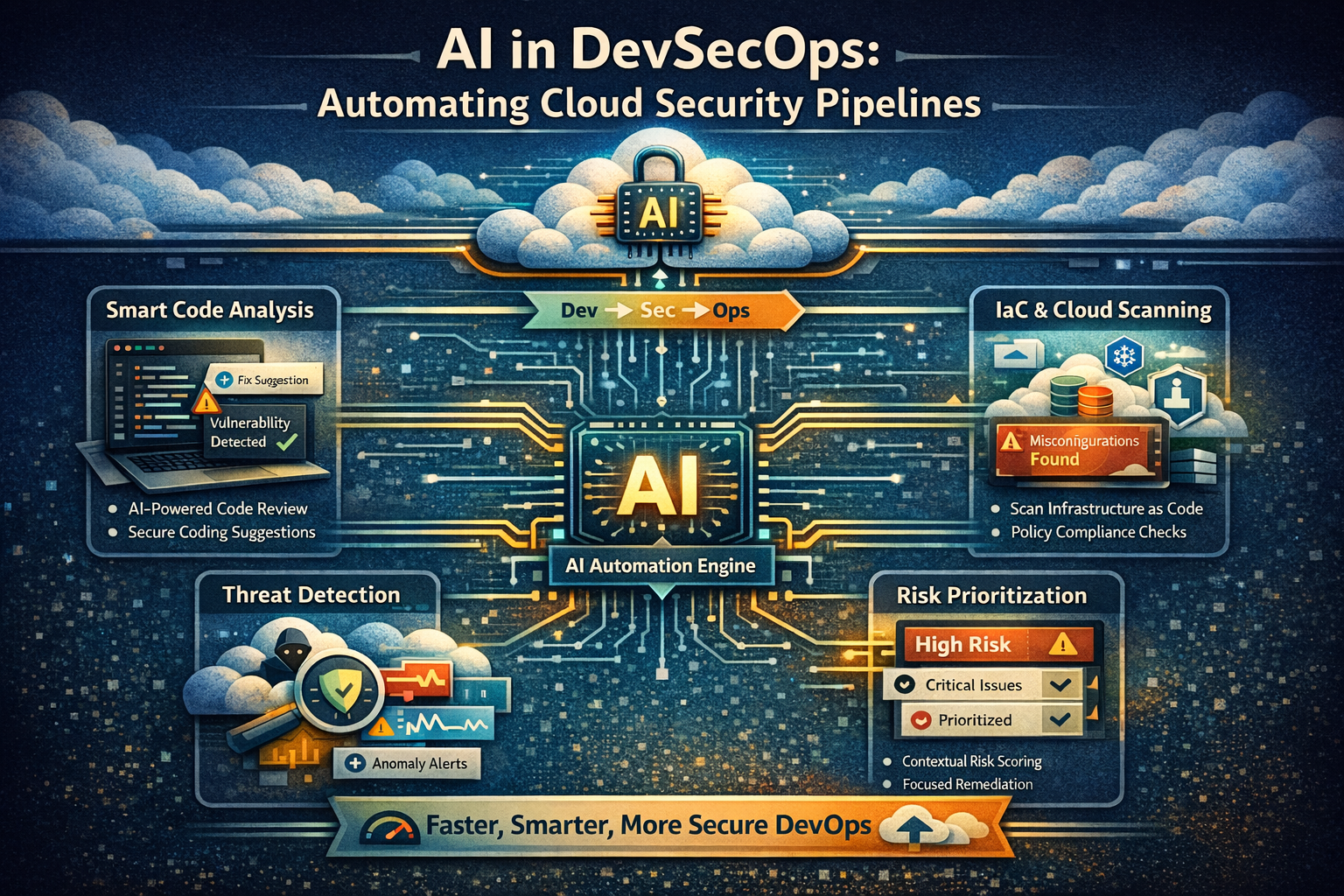
The real opportunity for AI in DevSecOps is not futuristic autonomy. It is intelligent automation that helps teams make faster, better security decisions inside the software delivery lifecycle.

Why DevSecOps Needs a New Operating Model
Modern software pipelines now include source control, CI/CD tooling, container registries, infrastructure as code, Kubernetes clusters, cloud identity systems, third-party APIs, and SaaS integrations. Every layer introduces new risk.
At the same time, security teams are often drowning in fragmented tooling. One platform scans code. Another reviews containers. Another watches runtime behavior. Another tracks identities and privileges. Each tool generates findings, but few provide enough context for engineering teams to act quickly.
The result is predictable. Developers receive too many alerts, many of them low priority. Security teams spend time triaging noise instead of reducing meaningful risk. Leadership sees growing spend without proportional improvement.
AI has the potential to break that cycle by turning raw signals into actionable intelligence.
– Dig Deeper –
AI Transforming DevSecOps Beyond Faster Coding

Q&A (Post your questions and get the answers you need)

Q. Is SAP ever going to embrace DevSecOps?
A. Yes, but SAP will embrace DevSecOps on SAP’s terms, not Silicon Valley’s terms..
SAP has already moved significantly in that direction, especially through SAP Business Technology Platform (BTP), CI/CD services, transport automation, security patch programs, and built-in code scanning for ABAP environments. SAP learning content now explicitly discusses integrating SAST tools, ABAP Test Cockpit (ATC), and Code Vulnerability Analyzer into CI/CD pipelines, which is classic DevSecOps behavior.
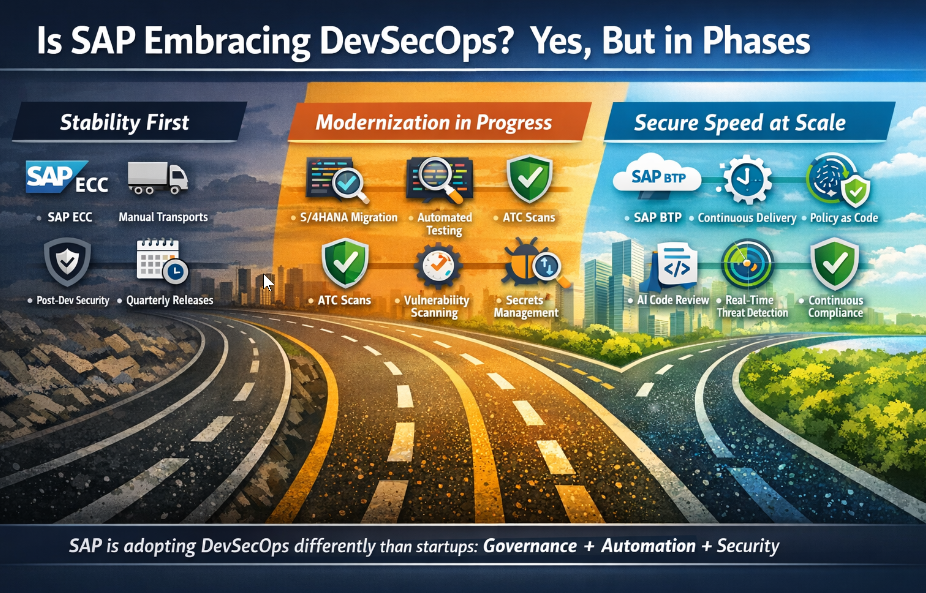
The challenge is that traditional SAP landscapes were built around governance, change control, transports, segregation of duties, and uptime for mission-critical ERP systems. That culture naturally prioritizes stability over rapid release velocity. In many SAP shops, quarterly change windows and CAB approvals mattered more than daily deployments. So SAP’s transition to DevSecOps has been slower because its customer base often values controlled risk more than startup-style speed.
Where SAP is changing fastest is cloud-native development. On SAP BTP, extensions, APIs, identity services, automated certificate renewal APIs, and modern pipeline tooling show a clear move toward continuous delivery with embedded security. Recent SAP BTP security releases continue adding automation features, which is a strong signal that DevSecOps maturity is increasing.
Where SAP still lags is in many on-premise ECC and older S/4HANA customer environments. Those ecosystems often depend on consultants, legacy custom code, manual Basis operations, and highly regulated change management. In those environments, “DevSecOps” is often partial adoption: automated scans, gated transports, secrets management, and testing, but not true continuous deployment.
I believe SAP absolutely will embrace DevSecOps, but it will look like governed enterprise DevSecOps rather than pure high-velocity DevSecOps. Think secure transports, policy-as-code, automated controls, continuous compliance, and AI-assisted remediation, not hundreds of prod releases per day. The real blocker is usually not SAP itself, but conservative customer operating models.
Cheers!