

TAKE NOTE (Insights and Emerging Technology)
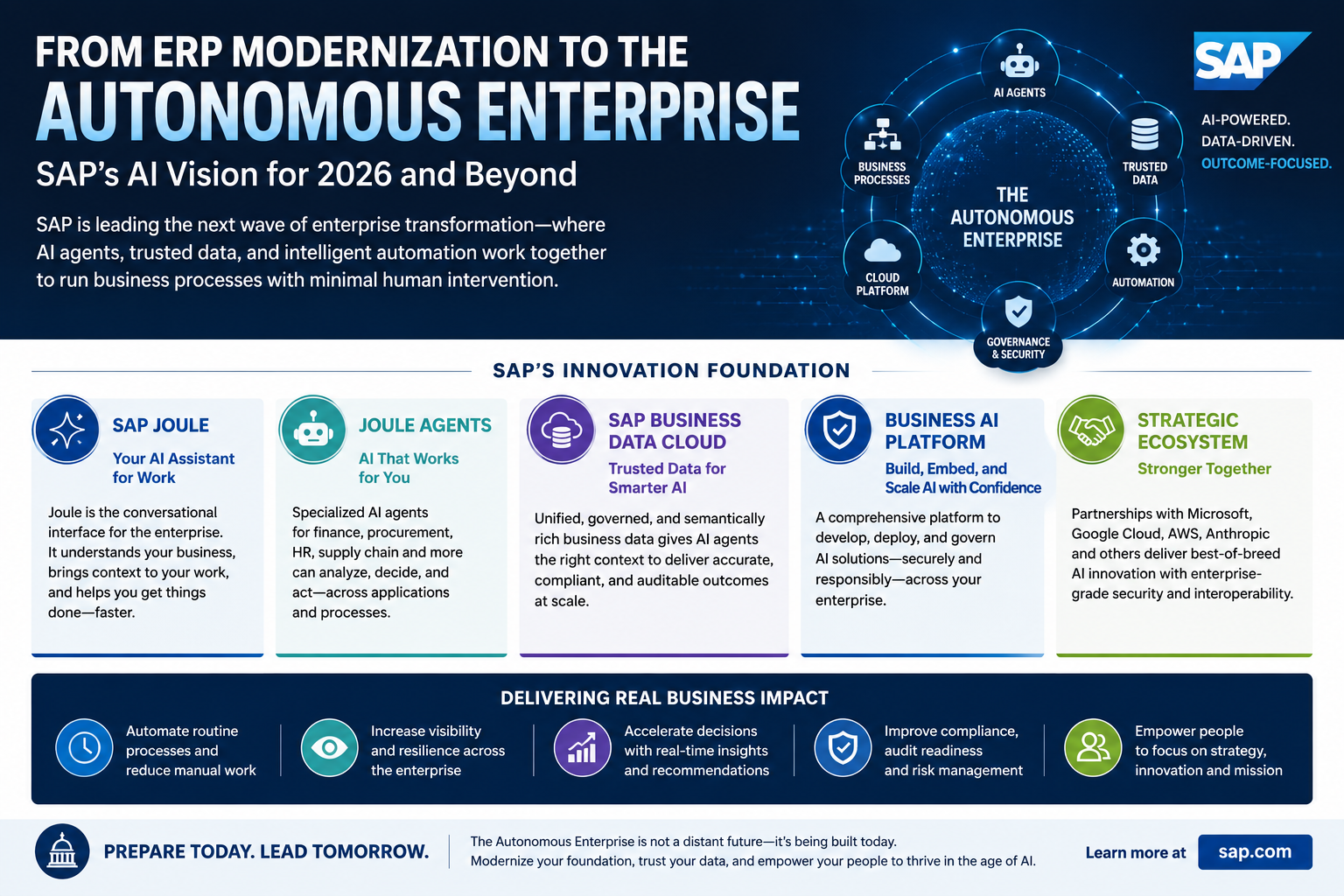
SAP’s biggest message this month is clear: the future of enterprise software is no longer just automation, it is autonomy. At SAP Sapphire 2026, SAP unveiled its vision for the Autonomous Enterprise, a strategy that combines AI agents, business process automation, enterprise data, and governance into a unified platform designed to execute business operations with minimal human intervention.
The initiative is built around the SAP Business AI Platform, SAP Autonomous Suite, and Joule Work, creating a foundation where AI can reason, act, and continuously optimize business processes.
At the center of this strategy is SAP Joule, which has evolved far beyond a traditional chatbot. SAP is now introducing specialized AI agents capable of supporting procurement, finance, human resources, customer experience, and supply chain operations. These agents can analyze business data, recommend actions, execute workflows, and collaborate with other systems, positioning Joule as the primary interface through which users interact with enterprise applications.
Another major component is SAP Business Data Cloud, which provides trusted business context for AI-driven decision making. Rather than relying solely on large language models, SAP’s approach combines enterprise data, process context, and governance controls to ensure that AI-generated actions remain accurate, compliant, and auditable. This is particularly important for organizations operating in highly regulated industries and government environments where transparency and accountability are critical.
For federal agencies, these developments represent more than just new technology capabilities. Large ERP environments supporting defense, logistics, financial management, and readiness operations generate enormous amounts of structured business data. As agencies continue modernizing legacy ERP platforms and moving toward cloud-enabled architectures, AI-powered capabilities offer opportunities to automate financial reconciliations, improve supply chain visibility, accelerate audit readiness activities, streamline acquisition processes, and enhance decision-making. Success, however, will depend on strong data governance, cybersecurity controls, identity management, and disciplined business process modernization. Agencies that establish these foundations today will be better positioned to leverage enterprise AI safely and effectively tomorrow
SAP is also expanding its AI ecosystem through partnerships with major technology providers including Microsoft, Google Cloud, AWS, and Anthropic. These partnerships are intended to improve AI interoperability, data integration, and access to advanced models while maintaining enterprise-grade governance. Combined with SAP’s expanding Business AI Platform, organizations will have greater flexibility to leverage AI technologies while preserving security, compliance, and operational control.
For SAP customers, the conversation is rapidly shifting from ERP modernization to AI-enabled business execution. While many organizations continue their S/4HANA transformations, SAP’s roadmap points toward a future where AI agents handle routine business processes, employees focus on exceptions and strategic decisions, and enterprise systems become increasingly autonomous. Organizations that invest today in data quality, process standardization, cloud modernization, and AI governance will be best positioned to capitalize on this next generation of enterprise transformation.
Read more at SAP link below
Interested in learning more about RPA? Download our FREE White Paper on “Embracing the Future of Work”
UNDER DEVELOPMENT (Insights for Developers)
How AI Is Redefining SAP Basis Operations
Intro
For decades, SAP Basis teams have served as the operational backbone of enterprise ERP environments. Their mission has been clear: keep systems available, monitor performance, manage transports, ensure security, and resolve issues before they impact the business.
This operational model has worked remarkably well. However, the complexity of modern SAP landscapes is rapidly outpacing the ability of traditional monitoring approaches to keep pace.
Organizations are managing hybrid architectures spanning SAP S/4HANA, cloud services, SAP Business Technology Platform (BTP), third-party integrations, cybersecurity controls, and increasingly complex data ecosystems. At the same time, expectations from leadership continue to rise. Systems must be available around the clock, performance issues must be identified before users notice them, and modernization initiatives must be executed without disrupting mission-critical operations.
The challenge is simple: monitoring alone is no longer enough. The next evolution of SAP Basis is not better dashboards. It is intelligence.
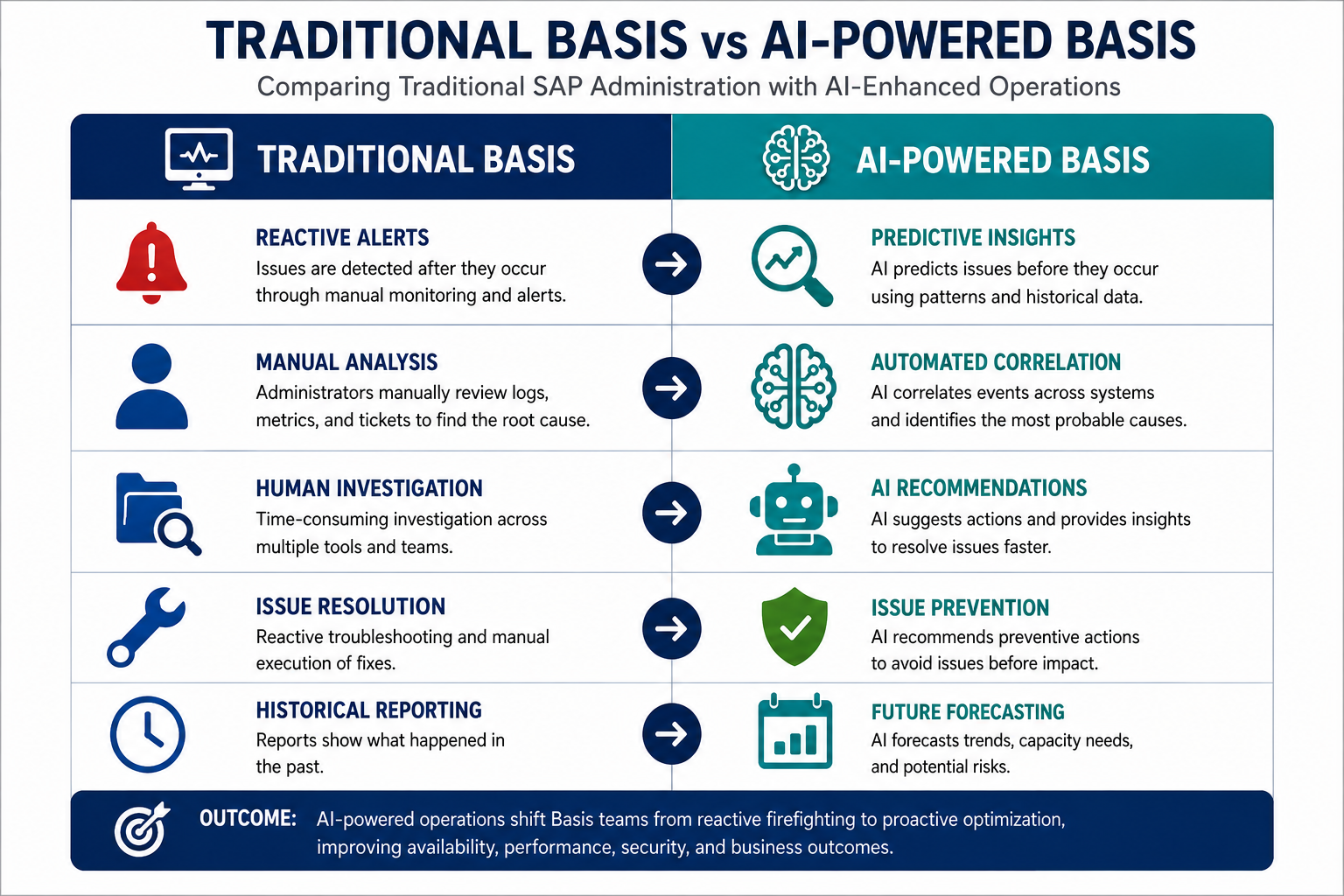
Artificial intelligence is transforming SAP operations from a reactive discipline focused on observing systems into a proactive discipline capable of predicting issues, recommending actions, and eventually automating many routine administrative tasks. This shift represents one of the most significant changes in SAP operations since the move from ECC to SAP S/4HANA.
For federal agencies and enterprise organizations alike, the question is no longer whether AI will become part of SAP administration. The question is how quickly organizations can position themselves to take advantage of it.

THE LIMITS OF TRADITIONAL SAP MONITORING
Most SAP environments today rely on a combination of monitoring tools, alerts, dashboards, and administrator expertise.
When a performance issue occurs, administrators investigate logs, review metrics, identify root causes, and implement corrective actions. This process works, but it is fundamentally reactive. Administrators are often responding after a problem has already impacted users.
Even sophisticated monitoring platforms face several limitations:
- Alert fatigue caused by excessive notifications
- Manual root-cause analysis
- Increasing landscape complexity
- Dependency on specialized personnel
- Delayed response times for emerging issues
As organizations migrate to cloud-enabled SAP architectures and integrate more business processes across platforms, the volume of operational data continues to grow exponentially.
Human operators simply cannot analyze every log entry, performance trend, integration dependency, and security signal in real time. This is where artificial intelligence begins to change the equation…
– Dig Deeper –
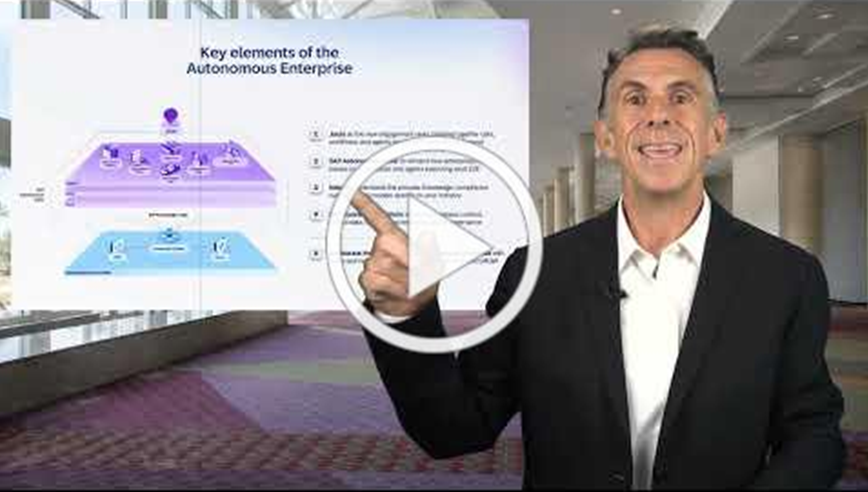
What is the Autonomous Enterprise?
Q&A (Post your questions and get the answers you need)

Q. If AI agents can execute business processes autonomously, what becomes the most important investment an organization can make today?
A. The answer may surprise you. It is not artificial intelligence itself. In my opinion, the organizations most likely to realize value from AI-driven automation will be those that first establish trusted data, standardized business processes, strong cybersecurity controls, and effective governance. AI agents can accelerate decision-making, automate routine work, and uncover insights at unprecedented speed, but they cannot compensate for inconsistent data, fragmented processes, or weak controls.
As SAP advances its vision of the Autonomous Enterprise through Joule, Business Data Cloud, and the Business AI Platform, the focus is shifting from simply implementing new technology to creating a reliable foundation on which that technology can operate. Organizations that have invested in modern ERP platforms, data quality, process discipline, identity management, and compliance frameworks will be able to adopt AI capabilities faster and with less risk.
The real question is no longer whether AI will transform enterprise operations. The question is whether organizations have built the operational and data foundations necessary to trust AI with increasingly important business decisions. Those that begin laying that groundwork today will be best positioned to leverage autonomous capabilities tomorrow and turn AI from an interesting technology into a measurable business advantage.
Cheers!