

 Anthony Cecchini is the President and CTO of Information Technology Partners (ITP), an ERP technology consulting company headquartered now in Virginia, with offices in Herndon. ITP offers comprehensive planning, resource allocation, implementation, upgrade, and training assistance to companies. Anthony has over 25 years of experience in SAP business process analysis and SAP systems integration. ITP is a Silver Partner with SAP, as well as an Appian, Pegasystems, and UIPath Low-code and RPA Value Added Service Partner. You can reach him at [email protected].
For decades, SAP Basis teams have served as the operational backbone of enterprise ERP environments. Their mission has been clear: keep systems available, monitor performance, manage transports, ensure security, and resolve issues before they impact the business.
This operational model has worked remarkably well. However, the complexity of modern SAP landscapes is rapidly outpacing the ability of traditional monitoring approaches to keep pace.
Organizations are managing hybrid architectures spanning SAP S/4HANA, cloud services, SAP Business Technology Platform (BTP), third-party integrations, cybersecurity controls, and increasingly complex data ecosystems. At the same time, expectations from leadership continue to rise. Systems must be available around the clock, performance issues must be identified before users notice them, and modernization initiatives must be executed without disrupting mission-critical operations.
The challenge is simple: monitoring alone is no longer enough. The next evolution of SAP Basis is not better dashboards. It is intelligence.
Artificial intelligence is transforming SAP operations from a reactive discipline focused on observing systems into a proactive discipline capable of predicting issues, recommending actions, and eventually automating many routine administrative tasks. This shift represents one of the most significant changes in SAP operations since the move from ECC to SAP S/4HANA.
For federal agencies and enterprise organizations alike, the question is no longer whether AI will become part of SAP administration. The question is how quickly organizations can position themselves to take advantage of it.
The Limits of Traditional SAP Monitoring 
Most SAP environments today rely on a combination of monitoring tools, alerts, dashboards, and administrator expertise.
When a performance issue occurs, administrators investigate logs, review metrics, identify root causes, and implement corrective actions. This process works, but it is fundamentally reactive. Administrators are often responding after a problem has already impacted users.
Even sophisticated monitoring platforms face several limitations:
- Alert fatigue caused by excessive notifications
- Manual root-cause analysis
- Increasing landscape complexity
- Dependency on specialized personnel
- Delayed response times for emerging issues
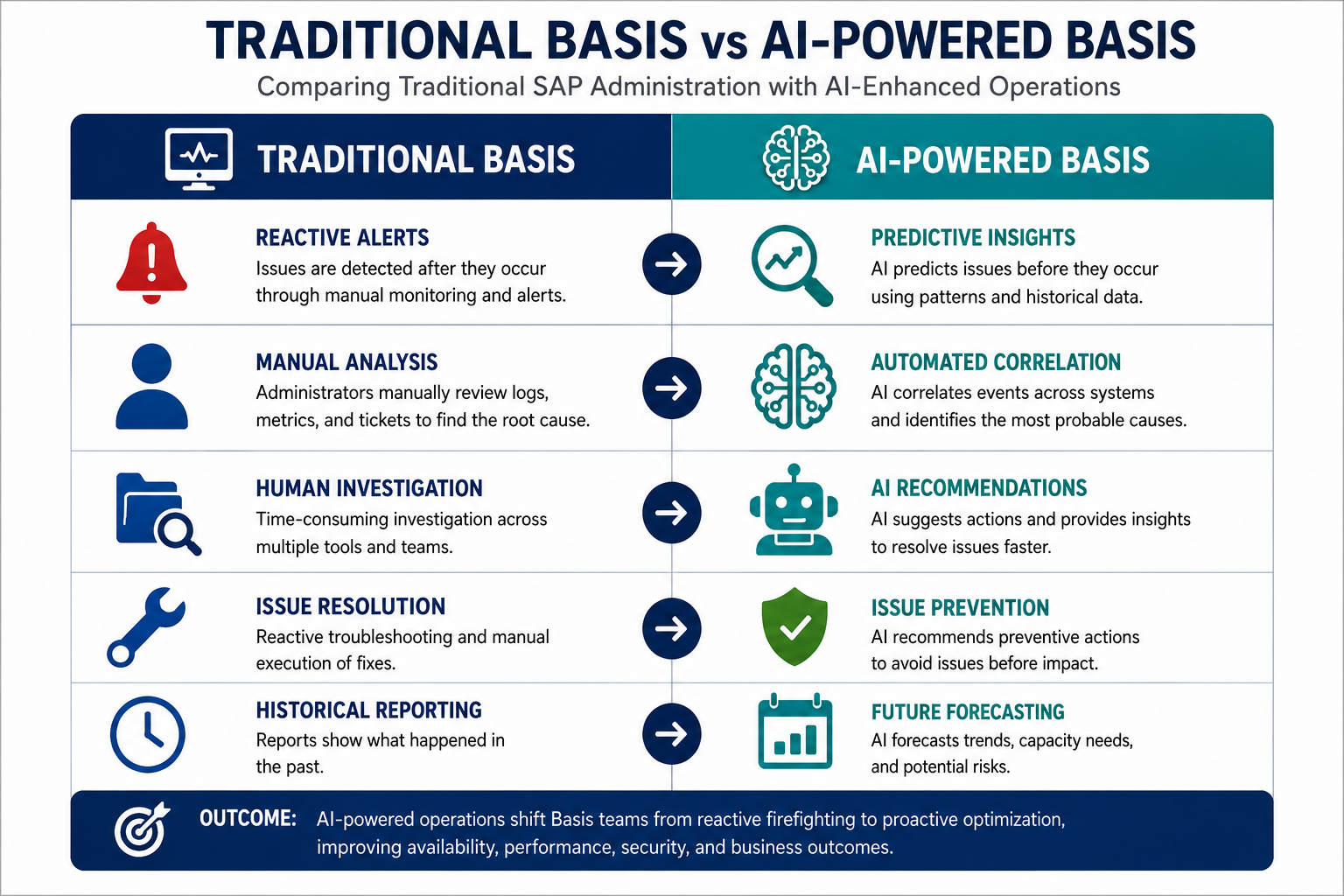 As organizations migrate to cloud-enabled SAP architectures and integrate more business processes across platforms, the volume of operational data continues to grow exponentially.
Human operators simply cannot analyze every log entry, performance trend, integration dependency, and security signal in real time. This is where artificial intelligence begins to change the equation.
The Shift from Observability to Intelligence
Traditional observability answers the question: “What is happening?”
Intelligent operations answer a different question: “What is likely to happen next?”
AI-driven operational platforms can continuously analyze historical patterns, correlate events across systems, identify anomalies, and recognize conditions that typically precede failures.
Rather than alerting administrators after a database bottleneck has impacted users, intelligent systems can recognize warning signs hours or even days before service degradation occurs.
This transition moves Basis operations through several stages of maturity:
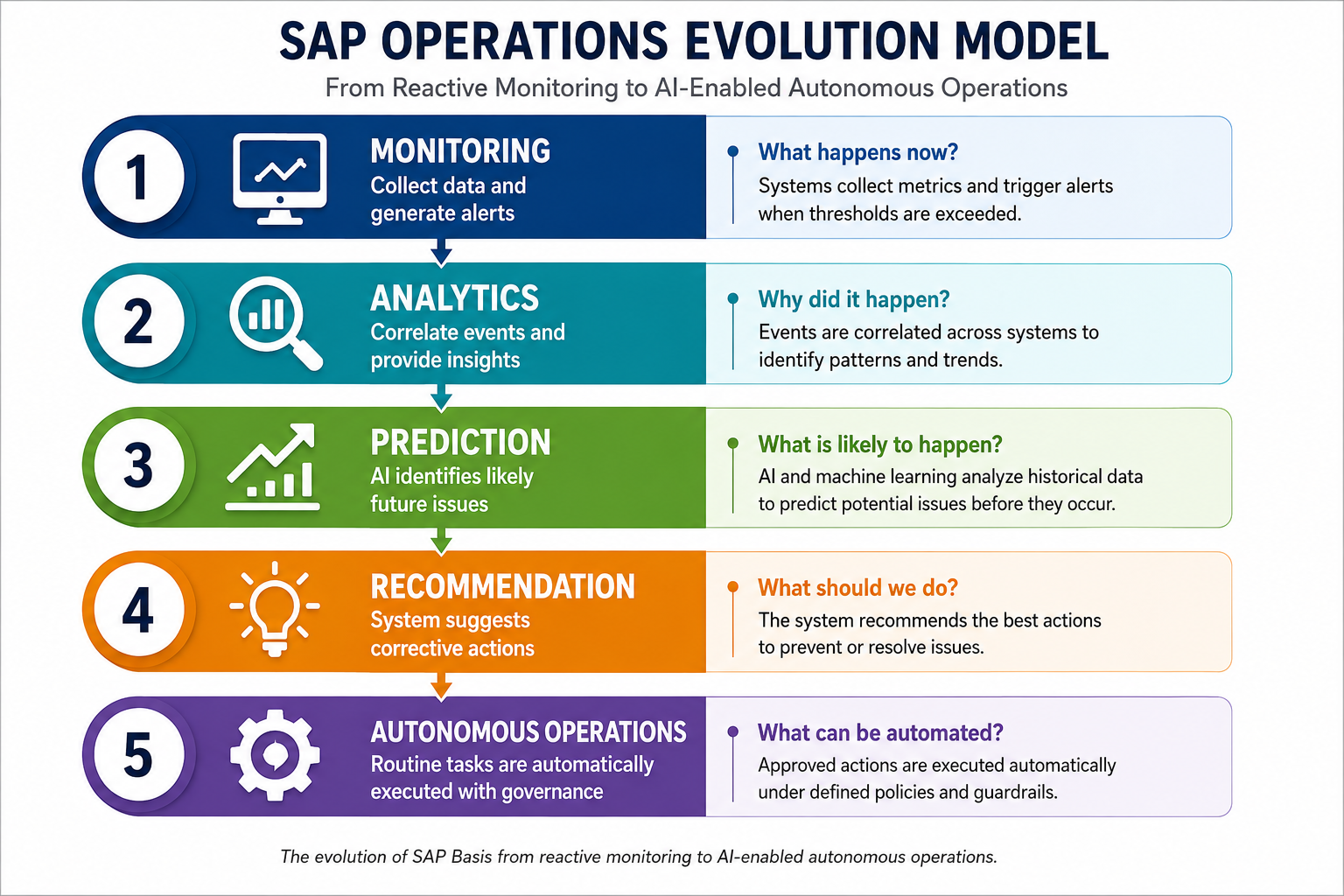
The long-term destination is not simply automation. It is the creation of an operational environment where administrators spend less time troubleshooting and more time enabling business transformation.
Predictive Operations in SAP Landscapes
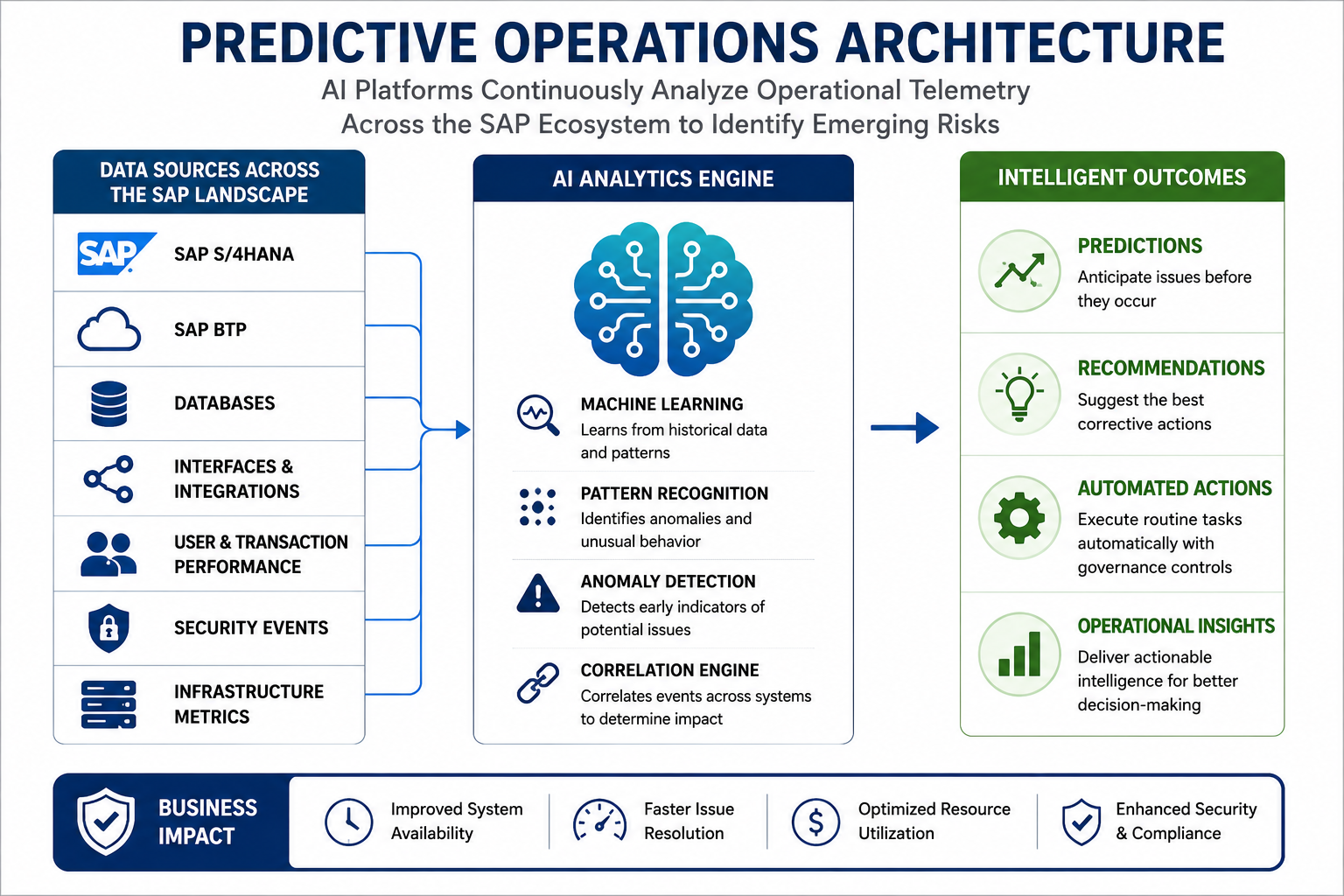 One of the most promising applications of AI in SAP Basis is predictive operations. Modern SAP environments generate enormous volumes of operational telemetry, including:
- Database performance metrics
- Memory utilization
- Application server health
- Work process activity
- Interface monitoring
- User transaction performance
- Security events
- Transport management data
Historically, much of this information has been reviewed only when problems occur.
AI systems can continuously analyze these datasets and identify subtle patterns that human operators might never detect. For example, an AI platform may recognize that a specific combination of memory growth, batch processing activity, and database response times has historically resulted in system slowdowns during month-end financial processing.
Rather than waiting for the slowdown to occur, the platform can alert administrators beforehand and recommend preventive actions.
This approach fundamentally changes how SAP environments are managed. Instead of firefighting, organizations begin practicing operational prevention.
Accelerating Root Cause Analysis
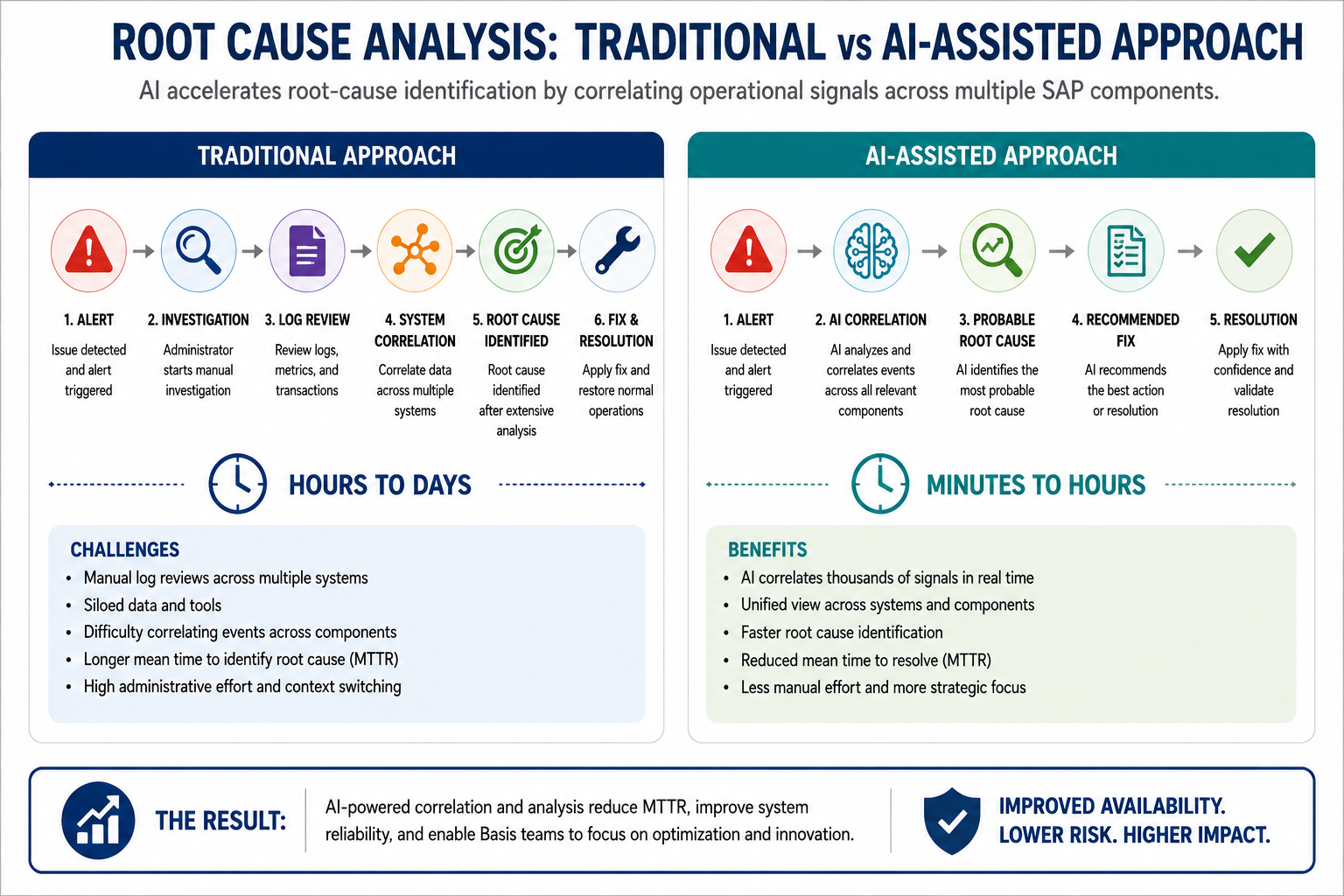 One of the most time-consuming responsibilities of Basis teams is identifying the root cause of performance issues.
An outage may involve multiple systems, integrations, infrastructure components, databases, network services, and application layers. Administrators often spend hours gathering evidence before determining the true source of a problem.
AI dramatically accelerates this process.
Machine learning models can correlate thousands of operational signals simultaneously and identify relationships that would be difficult for humans to detect manually. Rather than requiring administrators to review dozens of monitoring screens, AI can present a probable root cause along with supporting evidence and recommended actions.
This reduces mean time to resolution while improving overall service availability.
For organizations supporting mission-critical environments, faster diagnosis directly translates into reduced operational risk.
Intelligent Capacity Planning
Capacity planning has traditionally relied on historical usage trends and periodic forecasting exercises. While effective in stable environments, this approach becomes increasingly difficult as organizations adopt cloud services, expand digital capabilities, and integrate AI workloads.
AI-enabled capacity management provides a more dynamic approach.
By continuously analyzing system utilization patterns, business events, seasonal workloads, and growth trajectories, intelligent platforms can forecast future resource requirements with greater accuracy.
This enables organizations to:
- Reduce infrastructure costs
- Prevent performance bottlenecks
- Optimize cloud consumption
- Improve budgeting accuracy
- Support modernization initiatives more effectively
For federal agencies facing budget constraints and growing mission demands, intelligent capacity planning can deliver significant operational benefits.
Security and Compliance Enhancement
Cybersecurity remains one of the highest priorities across government and industry.
SAP environments often contain sensitive financial, personnel, logistics, and operational data. As a result, security monitoring and compliance activities consume significant administrative effort.
AI introduces new capabilities in this area.
Intelligent security systems can identify unusual user behaviors, detect abnormal access patterns, correlate events across multiple systems, and surface potential threats more rapidly than traditional rule-based approaches.
Rather than relying solely on predefined alerts, AI can identify previously unseen attack patterns by recognizing deviations from normal behavior.
This supports a more proactive cybersecurity posture while helping organizations meet compliance requirements.
As Zero Trust architectures continue to expand across federal agencies, AI-enhanced security monitoring will become increasingly important.
Supporting the SAP S/4HANA Journey
The transition from SAP ECC to SAP S/4HANA is already driving significant transformation across government and commercial organizations. Yet migration alone does not deliver long-term value.
Organizations must also modernize how they operate and maintain their environments.
SAP’s broader roadmap increasingly emphasizes cloud-native architectures, embedded analytics, automation, and artificial intelligence as core capabilities. Recent innovations across SAP’s portfolio demonstrate a clear strategic focus on AI-driven business operations and intelligent enterprise management.
As organizations move toward SAP S/4HANA and cloud-enabled architectures, AI-powered operations become a natural extension of the modernization journey.
The organizations that realize the greatest value from S/4HANA will not simply replicate legacy operating models on modern technology. They will embrace intelligent operations as a core component of their transformation strategy.
What This Means for Federal Agencies
Federal organizations face unique operational challenges.
Mission systems often support critical national functions. Downtime may impact financial management, logistics, readiness, acquisition, healthcare, or citizen services. At the same time, agencies face workforce challenges, budget pressures, cybersecurity requirements, and growing modernization mandates.
AI-enhanced SAP operations address several of these challenges directly.
Benefits include:
- Improved system availability
- Faster issue resolution
- Reduced operational overhead
- Enhanced cybersecurity monitoring
- Better resource utilization
- Increased operational resilience
- Reduced dependence on scarce technical expertise
Importantly, AI does not eliminate the need for experienced SAP professionals. Instead, it amplifies their effectiveness.
Basis administrators remain essential for governance, architecture, decision-making, and mission alignment. AI simply allows them to focus on higher-value activities instead of repetitive operational tasks.
Preparing for the Autonomous Enterprise
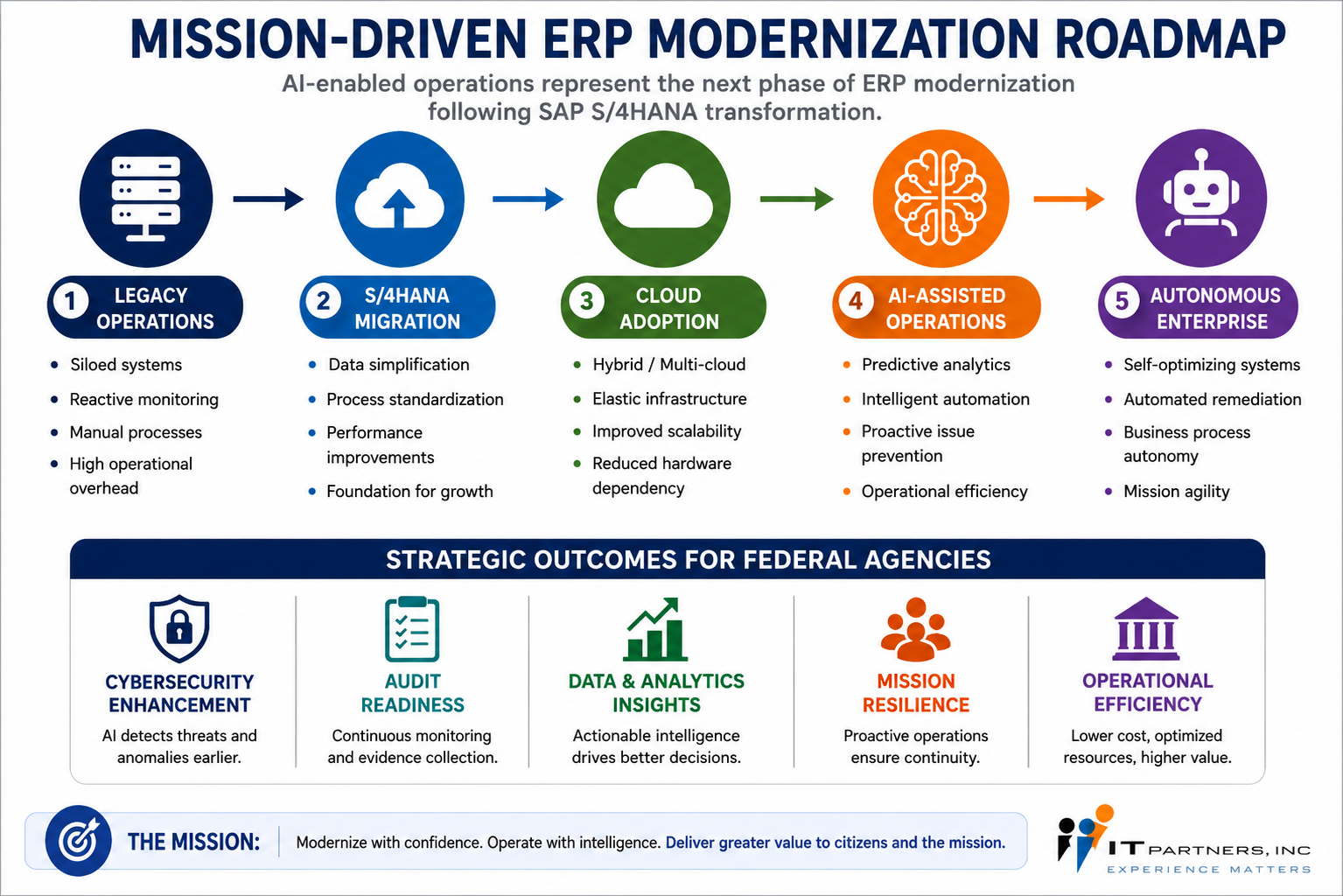 SAP’s strategic direction increasingly points toward what it describes as an autonomous enterprise, where AI agents, automation, enterprise data, and business processes work together to drive intelligent operations. Recent SAP announcements highlight investments in AI platforms, business data integration, automation, and autonomous process execution.
While fully autonomous SAP operations remain an emerging capability, organizations should begin preparing now.
Key steps include:
Modernize Monitoring Platforms
Legacy monitoring tools may not provide the data foundation required for AI-driven operations.
Improve Data Quality
AI effectiveness depends on accurate, complete, and well-governed operational data.
Standardize Operational Processes
Consistent procedures create the foundation for future automation.
Invest in Skills Development
Basis professionals should develop expertise in automation, analytics, cloud operations, and AI-enabled administration.
Establish Governance Frameworks
Organizations must define appropriate oversight and controls for AI-assisted decision making.
These foundational investments position organizations to take advantage of future innovations while maintaining operational stability.
Summary
The role of SAP Basis is evolving.
Historically, success was measured by the ability to monitor systems, resolve incidents, and maintain stability. Tomorrow’s Basis organizations will be judged by their ability to deliver intelligent operations, predict issues before they occur, automate routine activities, and enable business transformation.
This is not the end of SAP administration. It is the beginning of a more strategic era.
As AI continues to mature, the most successful organizations will move beyond simple monitoring and embrace intelligence as a core operational capability.
For federal agencies and enterprises navigating modernization initiatives, this shift offers an opportunity to improve performance, strengthen resilience, reduce operational costs, and create a foundation for the next generation of digital transformation.
The future of SAP Basis is intelligent.