

 Anthony Cecchini is the President and CTO of Information Technology Partners (ITP), an ERP technology consulting company headquartered now in Virginia, with offices in Herndon. ITP offers comprehensive planning, resource allocation, implementation, upgrade, and training assistance to companies. Anthony has over 25 years of experience in SAP business process analysis and SAP systems integration. ITP is a Silver Partner with SAP, as well as an Appian, Pegasystems, and UIPath Low-code and RPA Value Added Service Partner. You can reach him at [email protected].
As organizations continue their journey toward SAP S/4HANA, cloud adoption has become less of a question of if and more of when. Driven by the approaching end of mainstream maintenance for SAP ECC, increasing demands for agility, and the emergence of AI-powered business capabilities, enterprises across both the public and private sectors are accelerating their cloud strategies.
Yet despite billions of dollars invested in cloud migration initiatives, many organizations discover that moving SAP to the cloud does not automatically deliver the business transformation they expected.
Why?
Because migrating infrastructure and modernizing a business are two very different things.
Cloud migration is a technology initiative. Business modernization is an organizational transformation. While cloud provides the platform, modernization is what creates measurable value.
At IT Partners, we’ve found that organizations achieve the greatest return on their SAP investments when they treat cloud migration as the foundation for transformation rather than the transformation itself.
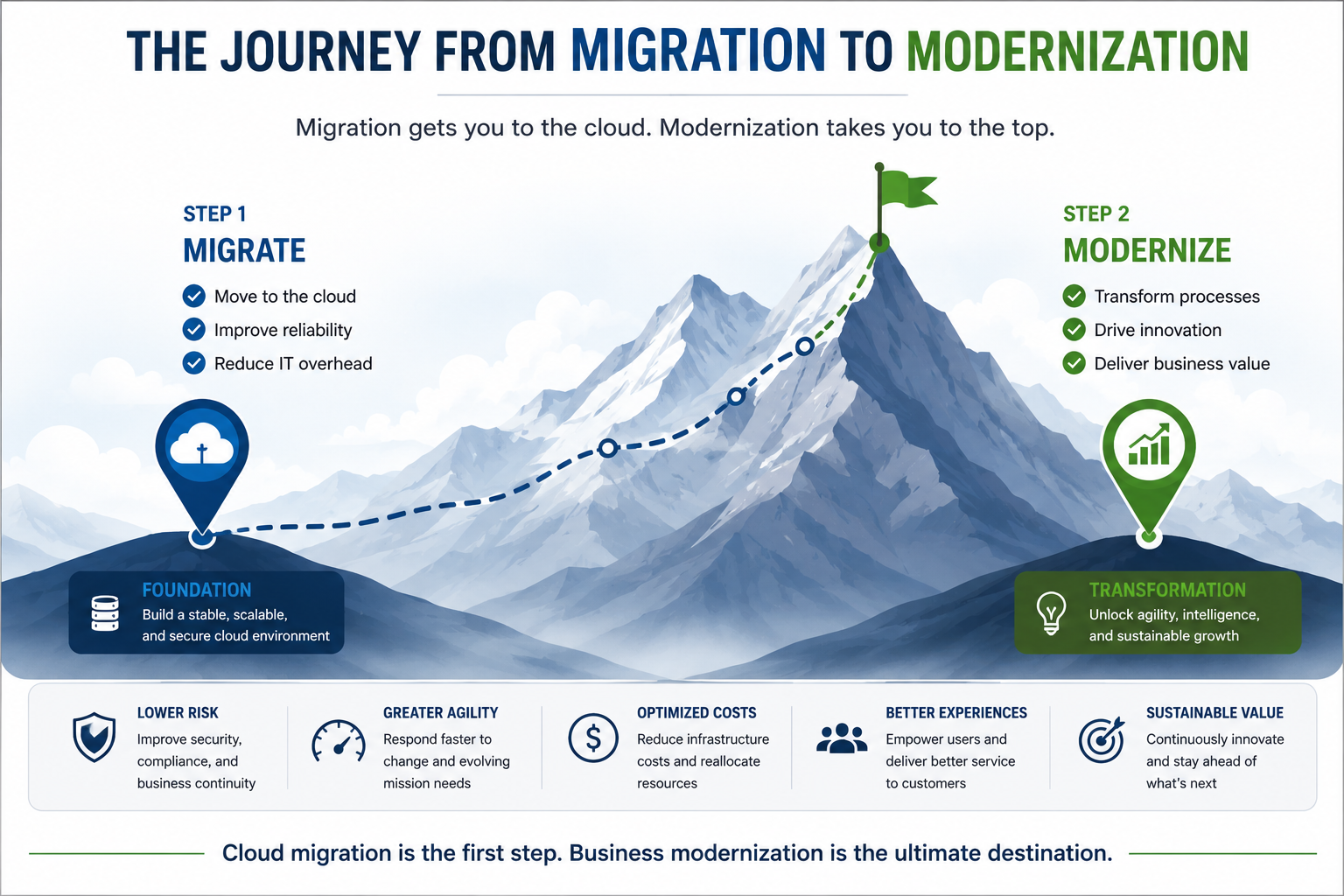 Migration Is the Beginning, Not the Destination
For years, organizations measured success by whether an implementation finished on time and within budget. Today’s leaders are asking a different question:
“How does this make the business operate better?”
Moving an SAP landscape from an on-premises data center into a cloud-hosted environment certainly provides operational advantages:
- Improved scalability
- Reduced infrastructure management
- Greater resiliency
- Faster provisioning
- Better disaster recovery
- Simplified patching and lifecycle management
These are meaningful improvements. However, none of them necessarily improve procurement cycle times, increase financial visibility, streamline logistics, reduce audit findings, improve customer service, or enable better executive decision making.
Those business outcomes require much more than a hosting change. Simply relocating existing processes into the cloud without addressing decades of accumulated technical debt often results in what many organizations jokingly refer to as “the world’s most expensive lift and shift.”
The Hidden Cost of Carrying Yesterday into Tomorrow
Every mature SAP environment contains history.
- Years of enhancements.
- Custom reports.
- Legacy integrations.
- Department-specific workflows.
- Manual workarounds.
- Business rules that may no longer serve their original purpose.
Many organizations assume every customization represents critical business functionality. In reality, a significant percentage exists because the software could not support a requirement years ago that SAP now provides as standard functionality.
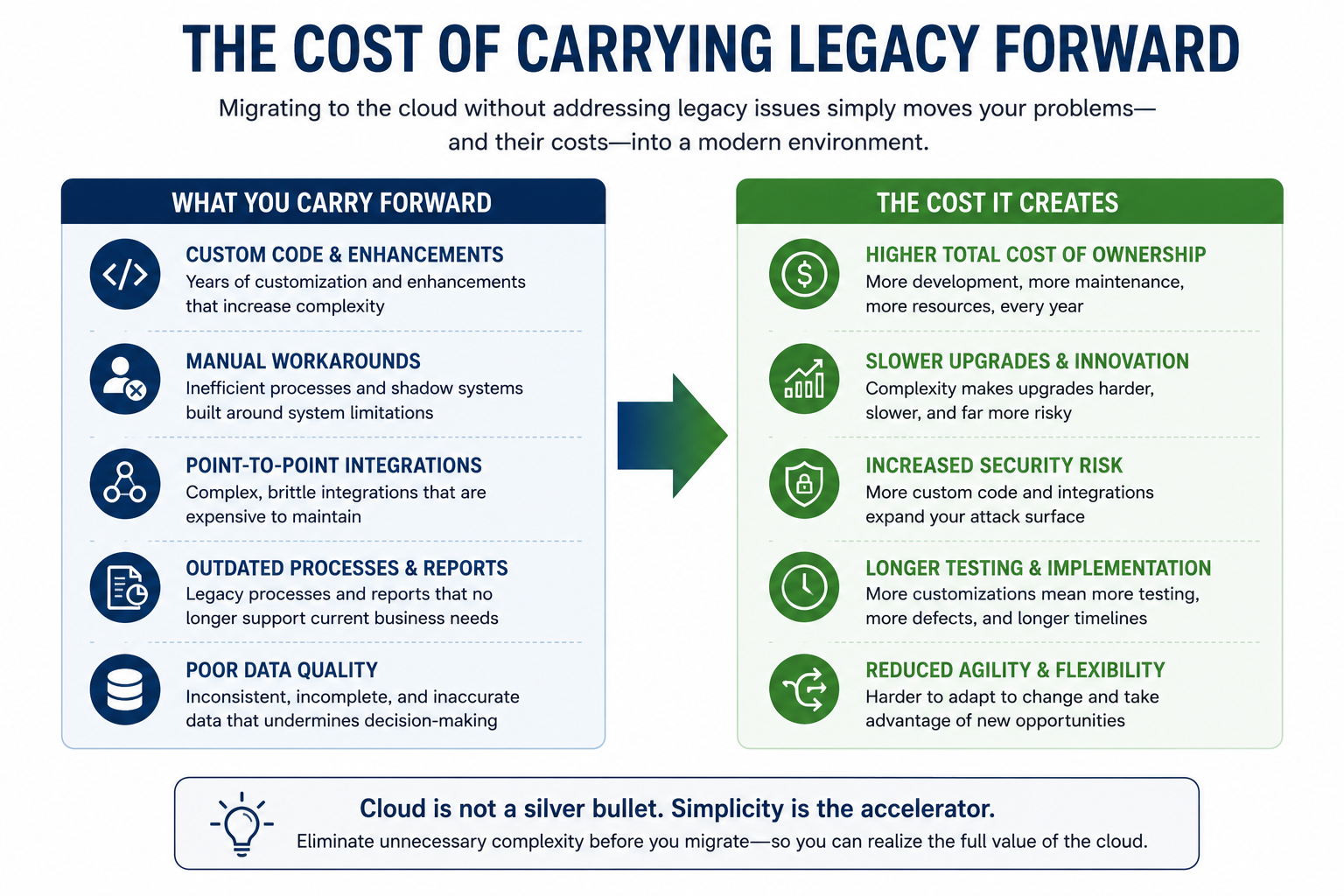 Carrying unnecessary customization into a cloud environment creates several long-term challenges:
- Increased implementation complexity
- Longer testing cycles
- More difficult upgrades
- Higher maintenance costs
- Greater cybersecurity exposure
- Reduced flexibility for future innovation
Cloud migration presents a rare opportunity to evaluate what should remain, what should be redesigned, and what should simply be retired. Organizations that use migration as an opportunity to simplify frequently realize greater long-term benefits than those that simply replicate their existing environment.
Modernization Starts with Business Processes
One of the most common mistakes organizations make during SAP transformation is attempting to recreate every existing workflow exactly as it exists today. This is exactly what we did back in the early 2001 – 2005 era when we first brought SAP into the Government. But its worse now, because that approach often ignores years of process improvements embedded within modern SAP solutions.
Instead of asking:
“How do we make the new system behave exactly like the old one?”
Organizations should ask:
“How should this process operate today?”
This changes the conversation, and rather than rebuilding legacy workflows, transformation teams begin examining opportunities to:
- Standardize operations across business units
- Eliminate redundant approvals
- Reduce manual data entry
- Increase automation
- Improve visibility across the enterprise
- Simplify reporting
- Strengthen governance
Business process modernization often delivers greater value than any individual technology enhancement.
The Importance of a Clean Core
How many upgrades have we all done that should have been a week but instead went onto months….
We know why, because historically, organizations frequently customized SAP directly within the ERP system. While this solved immediate business challenges, it often created significant obstacles during future upgrades.
Modern SAP architecture encourages a different approach. Central to successful SAP modernization initiatives is maintaining a clean core.
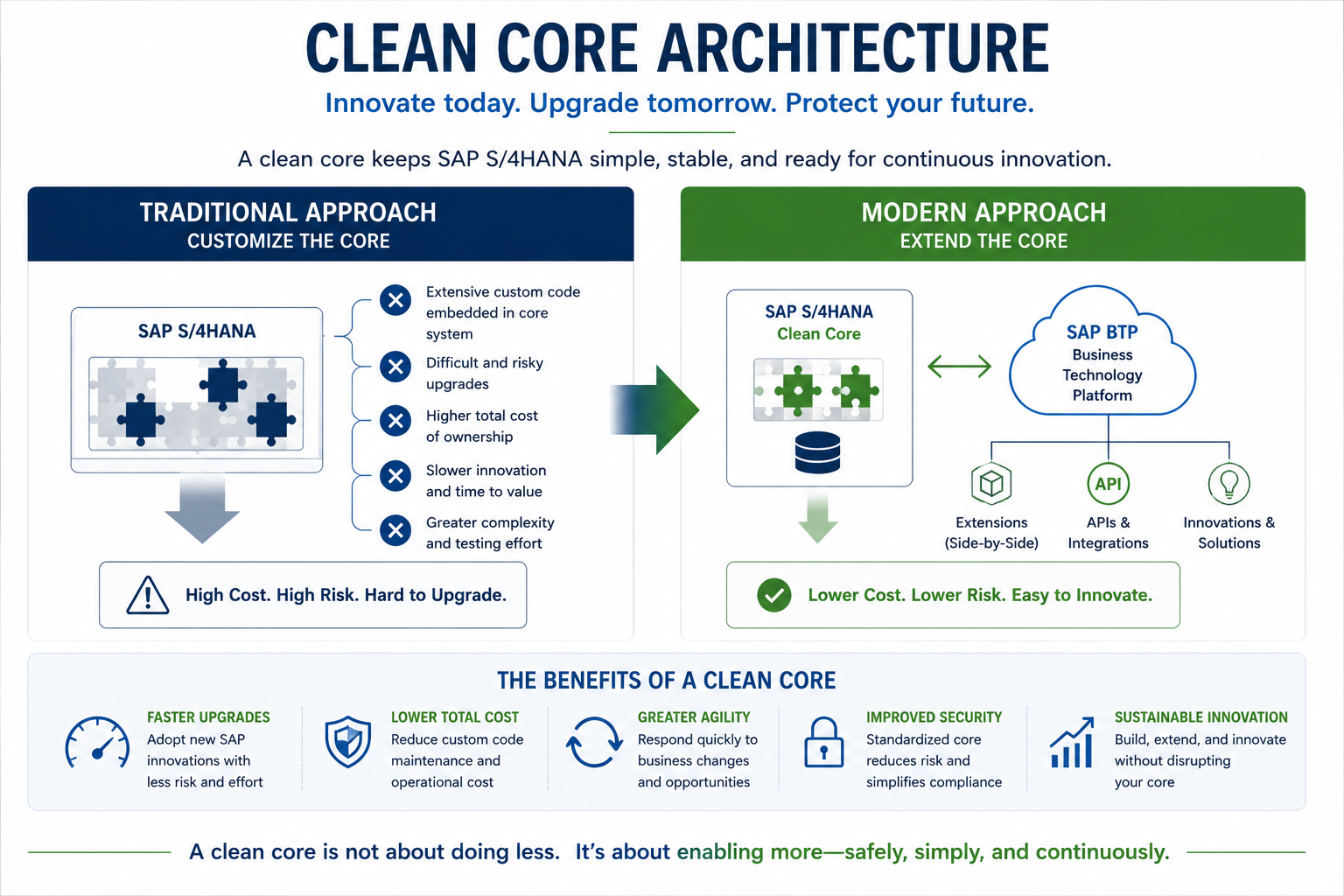 Instead of modifying the ERP itself, organizations extend capabilities through SAP Business Technology Platform (SAP BTP), APIs, and loosely coupled services.
The benefits are substantial.
A clean core enables:
- Faster upgrades
- Lower implementation risk
- Easier adoption of new SAP innovations
- Improved security
- Reduced technical debt
- Greater operational stability
Perhaps most importantly, it allows organizations to innovate continuously without placing future modernization efforts at risk.
We Need Better Integration, Not More Integration
Enterprise environments continue to become more complex.
SAP rarely operates in isolation. It exchanges information with:
- Human capital systems
- Identity management platforms
- Supply chain applications
- Financial institutions
- Customer relationship management systems
- Government systems
- Third-party SaaS applications
- Analytics platforms
Cloud transformation should not increase integration complexity. It should simplify it.
Modern integration strategies emphasize:
- API-first architecture
- Event-driven communication
- Standard interfaces
- Reusable services
- Centralized governance
Organizations that continue building point-to-point integrations often create new technical debt that quickly offsets many cloud benefits.
Data Quality Matters More Than Ever
Cloud migration exposes data challenges that have accumulated over many years.
- Duplicate vendors.
- Obsolete materials.
- Inactive users.
- Inconsistent master data.
- Conflicting business rules.
Poor data quality affects everything from financial reporting to AI recommendations. Modernization projects should include comprehensive data governance initiatives that establish:
- Clear ownership
- Standard definitions
- Validation processes
- Lifecycle management
- Ongoing stewardship
Data that is trustworthy, is not simply an IT objective. It is a business asset.
What About security
Cloud environments introduce new opportunities, but they also require disciplined governance. Security cannot be viewed as a checkpoint at the end of implementation. It must be incorporated throughout modernization efforts.
Successful organizations integrate security into:
- Identity and access management
- Zero Trust architecture
- Role design
- Data protection
- API governance
- Compliance monitoring
- Continuous auditing
For federal agencies and regulated industries, modernization must also preserve compliance while enabling innovation.
The goal is not choosing between security and agility. Modern architectures allow organizations to achieve both.
Modernized Organizations vs Migrated Organizations
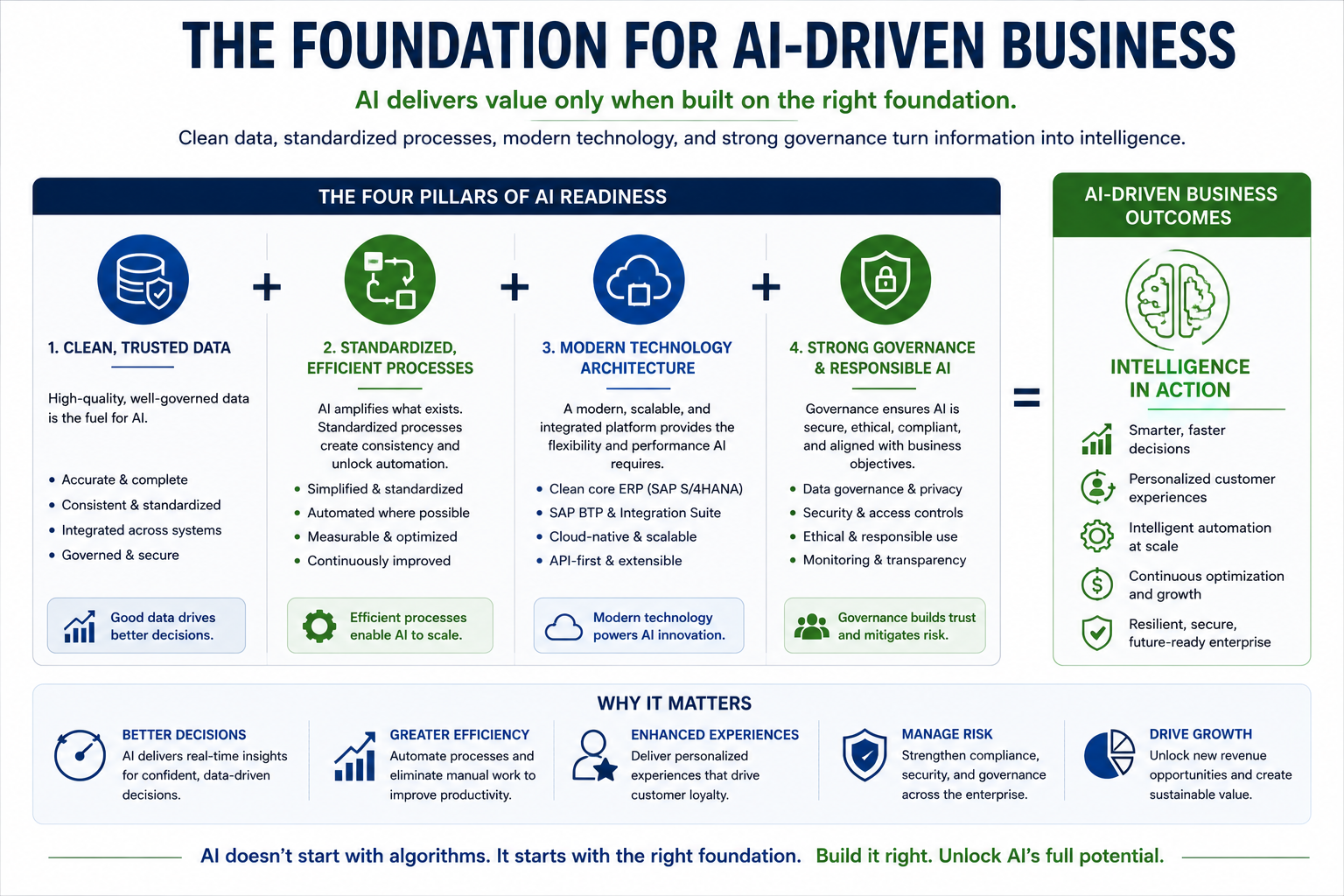 Artificial intelligence is rapidly becoming the defining capability of next-generation enterprise platforms.
Organizations frequently ask whether they are “ready for AI.” The better question is whether they have modernized enough to use AI effectively.
AI depends on:
- Clean data
- Standardized business processes
- Modern integrations
- Well-defined governance
- Reliable master data
- Scalable cloud infrastructure
Without these foundations, AI simply accelerates existing inefficiencies.
Organizations that modernize business processes before introducing AI are positioned to realize far greater value from intelligent automation, predictive analytics, and autonomous operations.
Cloud creates the platform while modernization creates the capability.
Summary
Cloud migration has become an essential milestone for organizations seeking to remain competitive.
Yet cloud alone is not the objective, modernization is.
The organizations that achieve the greatest return on their SAP investments are not simply those that move systems to the cloud first. They are the ones that use cloud as the catalyst for rethinking how the business operates.
- They simplify rather than replicate.
- They standardize rather than customize.
- They integrate intelligently rather than adding complexity.
- They build clean architectures that support continuous innovation.
Most importantly, they recognize that successful transformation is measured not by where applications run, but by how effectively the business performs.
Cloud migration may be the first step. Business modernization is what ultimately delivers lasting value.