

 Anthony Cecchini is the President and CTO of Information Technology Partners (ITP), an ERP technology consulting company headquartered now in Virginia, with offices in Herndon. ITP offers comprehensive planning, resource allocation, implementation, upgrade, and training assistance to companies. Anthony has over 25 years of experience in SAP business process analysis and SAP systems integration. ITP is a Silver Partner with SAP, as well as an Appian, Pegasystems, and UIPath Low-code and RPA Value Added Service Partner. You can reach him at [email protected].
Migrating from SAP Process Orchestration to SAP Integration Suite can be a challenge. For many large SAP environments, SAP Process Integration and SAP Process Orchestration have served as the connective tissue of the enterprise for years.
PO often sits between SAP ERP and dozens, sometimes hundreds, of external systems. It handles IDocs, files, web services, databases, supplier connections, custom applications, legacy systems, and business-to-business transactions that the organization depends on every day.
That history is exactly what makes migrating from SAP Process Orchestration to SAP Integration Suite more complicated than simply replacing one integration platform with another.
The technical migration matters, but the larger opportunity is architectural.
Organizations already moving toward SAP S/4HANA, cloud applications, SAP Business Technology Platform, API-driven integration, and increasingly event-driven architectures should not carry every legacy integration decision into the new environment. The right objective is not simply to move SAP PO to the cloud. It is to use the transition from SAP PO to establish a simpler, more standardized, and more adaptable integration architecture. That distinction should drive the entire migration strategy.
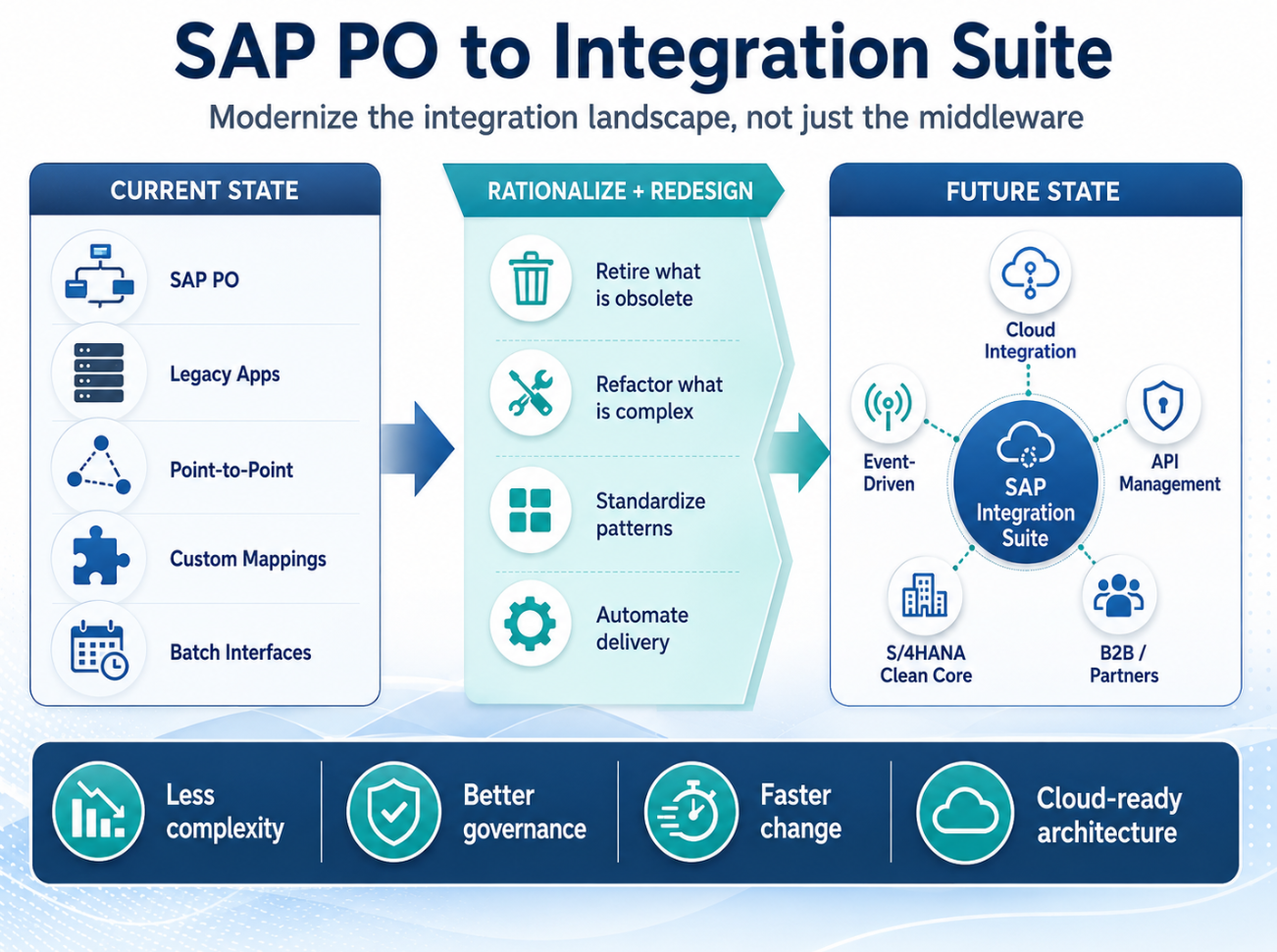 SAP PO Migration Is Part of a Larger Modernization Journey
SAP Process Orchestration 7.5 remains under mainstream maintenance through the end of 2027, with optional extended maintenance available through 2030. Those dates understandably create urgency, but approaching the initiative purely as an end-of-support project can lead organizations directly into the wrong migration strategy.
A deadline-driven program tends to focus on interface counts, conversion schedules, staffing requirements, and the date PO can finally be turned off. Those are necessary questions, but they are not sufficient.
A modernization program goes further. It asks whether every existing integration still needs to exist, whether certain point-to-point connections should be eliminated, whether some services should become governed APIs, whether synchronous interfaces should become event-driven, and whether custom mappings or integrations can be consolidated into reusable patterns.
That changes the outcome dramatically. One approach replaces the middleware platform while preserving most of the legacy architecture. The other uses the migration as an opportunity to simplify the integration landscape itself.
Start With Rationalization, Not Development
The first phase of a PO migration should not involve rebuilding interfaces. It should involve understanding them. Large SAP customers frequently have integration landscapes that have accumulated over ten or fifteen years. During that time, ERP environments change, business units reorganize, applications are replaced, vendors come and go, and integration requirements evolve. Middleware environments rarely get cleaned up at the same pace.
The result can be hundreds or thousands of integration objects with dramatically different levels of business importance. Some are mission-critical. Others process only a handful of transactions. Some may be duplicates. Others may connect systems that are already scheduled for retirement. Still others may exist because no one has been willing to determine whether they can safely be removed.
SAP’s Migration Assessment capability provides an important technical starting point for analyzing existing SAP Process Orchestration scenarios and evaluating their migration characteristics. But the technical analysis should be combined with business rationalization.
Every interface should ideally be tied back to a business capability or process. An IDoc-to-REST integration may technically be described by its protocol and mapping logic, but from the business perspective it could represent order creation, financial posting, supplier onboarding, inventory movement, or logistics execution. That business context matters because it determines priority, criticality, testing requirements, and acceptable migration risk.
Every Integration Should Face a Deliberate Decision
Once the landscape is understood, organizations should resist the temptation to assume that every PO object belongs in Integration Suite.
Instead, every integration should effectively face one of four decisions: retire it, migrate it, refactor it, or modernize it.
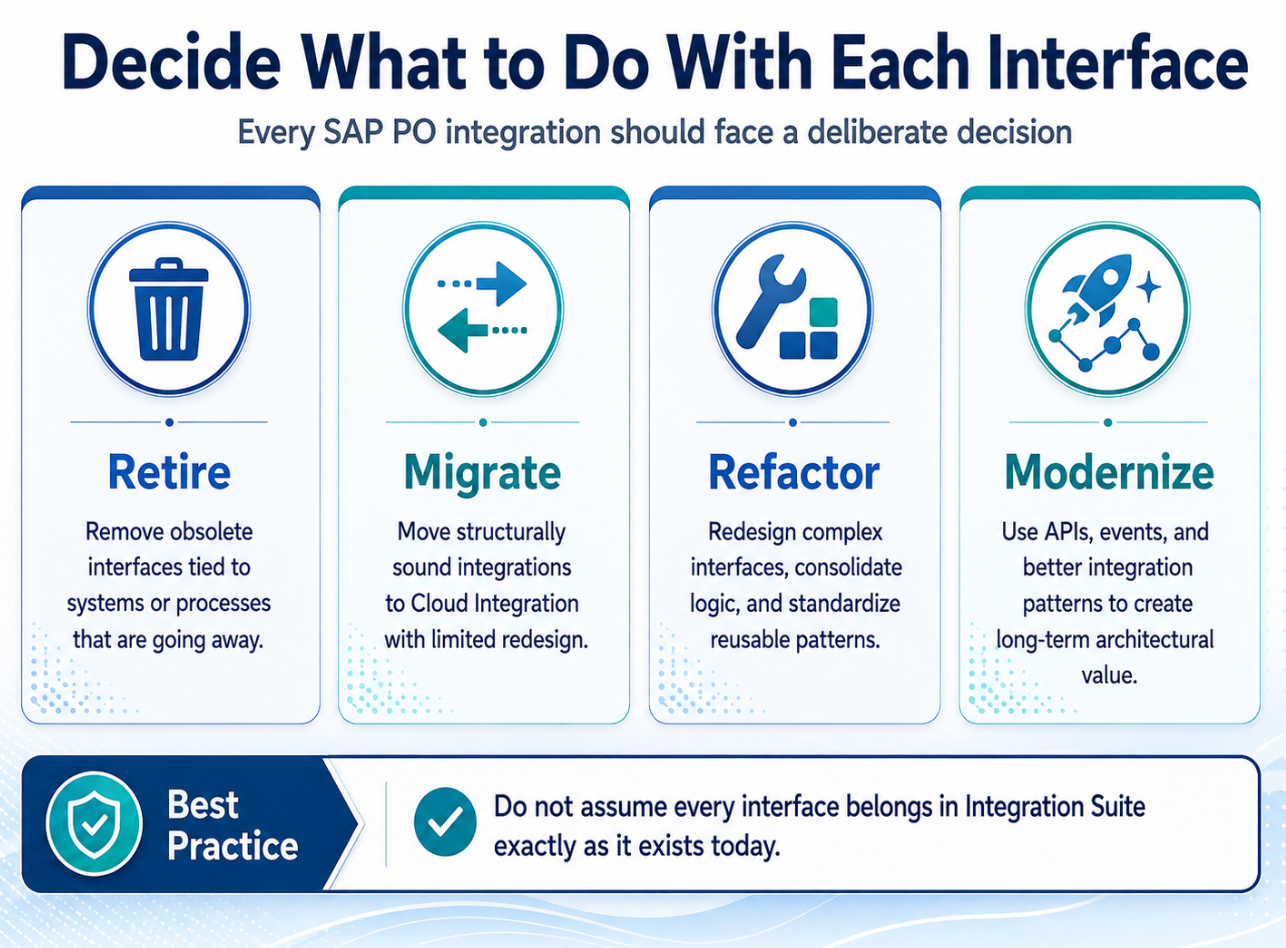 Some interfaces should simply be retired. If the underlying application, process, or business requirement is disappearing, there is little value in recreating the interface in a new platform. Every interface eliminated before migration is one that never has to be redesigned, built, tested, secured, monitored, or maintained again.
Other integrations are structurally sound and can be migrated with relatively limited redesign. Cloud Integration supports many of the traditional application integration patterns historically handled through PI and PO, and SAP provides tooling that can accelerate the migration of supported artifacts and scenarios.
A third group will need to be refactored. These are interfaces whose business purpose remains valid but whose technical implementation reflects years of accumulated complexity. A custom mapping may now be replaceable with a standard capability. Several similar interfaces may be consolidated. A repeated pattern may become a reusable component rather than being rebuilt separately.
Then there are the integrations that should be fundamentally modernized. A synchronous request-response interface may be better implemented as an event. A custom service may belong behind API Management. Multiple supplier connections may be candidates for a more standardized B2B approach. Several application-specific interfaces may be able to consume a reusable enterprise API rather than each connecting independently to SAP.
This is where the migration begins producing architectural value rather than merely eliminating PO.
Use S/4HANA as an Architectural Forcing Function
For organizations migrating to SAP S/4HANA, the integration strategy becomes even more important. S/4HANA programs understandably focus heavily on the ERP transformation itself, including Fit-to-Standard, process redesign, data migration, configuration, extensions, testing, and cut-over. But integration architecture can either reinforce that modernization effort or undermine it.
If S/4HANA replaces ECC while hundreds of tightly coupled legacy interfaces remain largely unchanged, the organization has modernized the ERP while preserving much of the surrounding technical debt. A better approach is to treat the PO transition and the S/4HANA program as coordinated architecture initiatives.
That is especially important in the context of SAP’s clean-core principles. A clean-core strategy seeks to minimize unnecessary customizations and tightly coupled extensions inside S/4HANA. Integration Suite can support that objective by moving integration concerns outside the ERP core and creating standardized boundaries between S/4HANA and the wider application landscape.
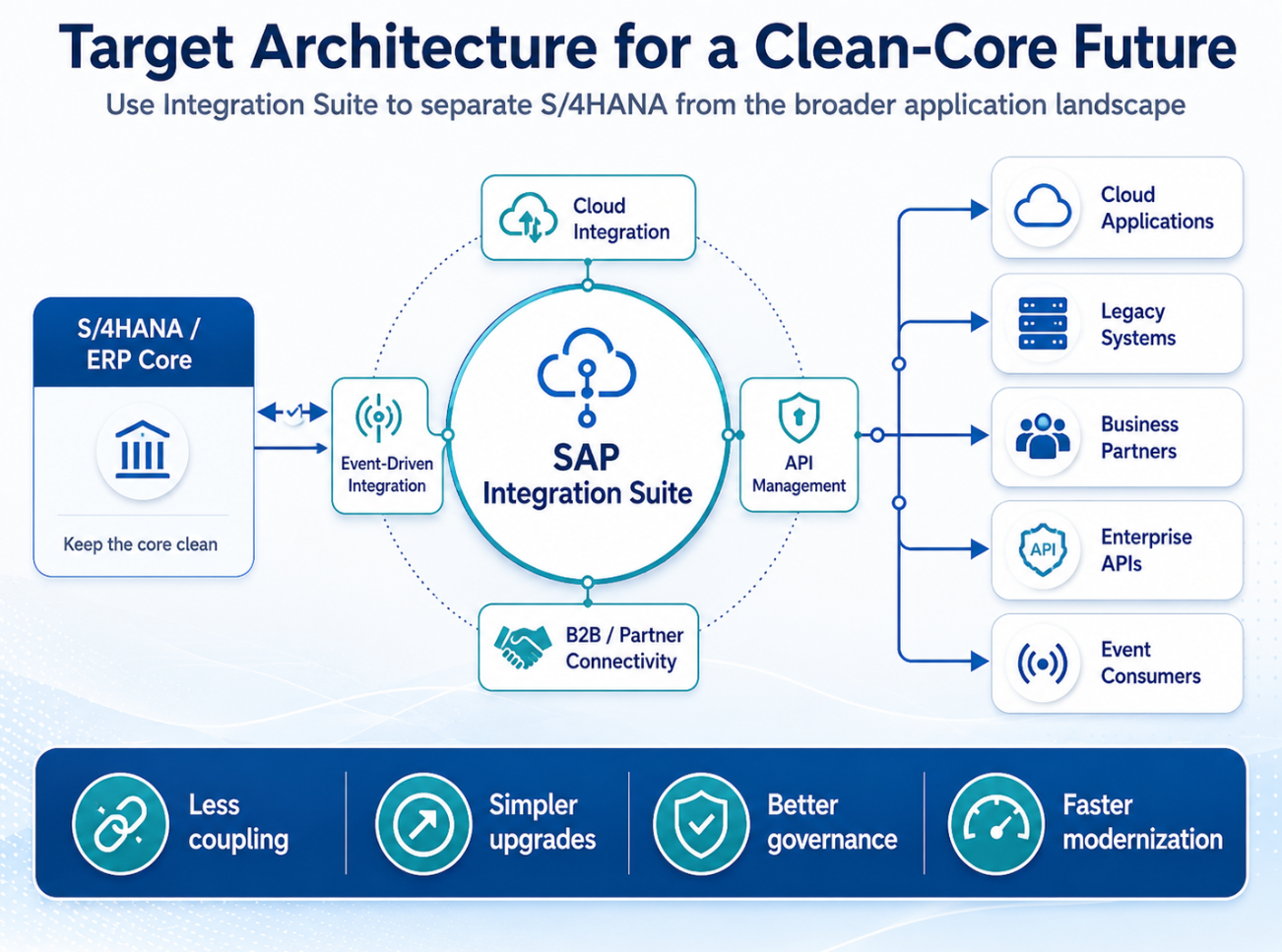
Instead of every consuming system understanding the internal structure of S/4HANA, APIs and integration services can provide more stable and reusable interfaces. That reduction in coupling has long-term consequences. It makes SAP upgrades easier, reduces the impact of application changes, supports broader cloud adoption, and improves the organization’s ability to modernize over time.
Define the Target Architecture Before Development Starts
One of the most common mistakes in large migrations is allowing development to begin before architectural standards are established. The outcome is predictable. Different teams solve similar problems in different ways. One team uses custom scripting. Another creates a reusable integration pattern. Another exposes a backend service directly. Another creates an API. Within a few years, the new Integration Suite environment starts accumulating the same inconsistencies the migration was supposed to eliminate.
The target architecture therefore needs to be established before the migration factory begins operating at scale. Organizations should define clear guidance for when Cloud Integration should be used for orchestration, transformation, routing, and application connectivity; when API Management should be used to expose and govern business services; when event-driven patterns are appropriate; and when B2B or Trading Partner Management should be applied to external partner integration.
Just as important are the standards beneath those architectural choices. The organization should have clear conventions around naming, security, logging, error handling, certificate and secrets management, transports, monitoring, testing, version control, documentation, and reusable integration components.
Those decisions are what turn Integration Suite from another middleware product into an enterprise integration capability.
Build a Factory, Not a Series of Individual Projects
Large PO migrations benefit from an industrialized delivery model.
Instead of treating hundreds of interfaces as independent development efforts, organizations should create a repeatable migration factory in which each integration moves through the same basic lifecycle: discovery, assessment, rationalization, design, build, test, deployment, validation, and transition to operations.
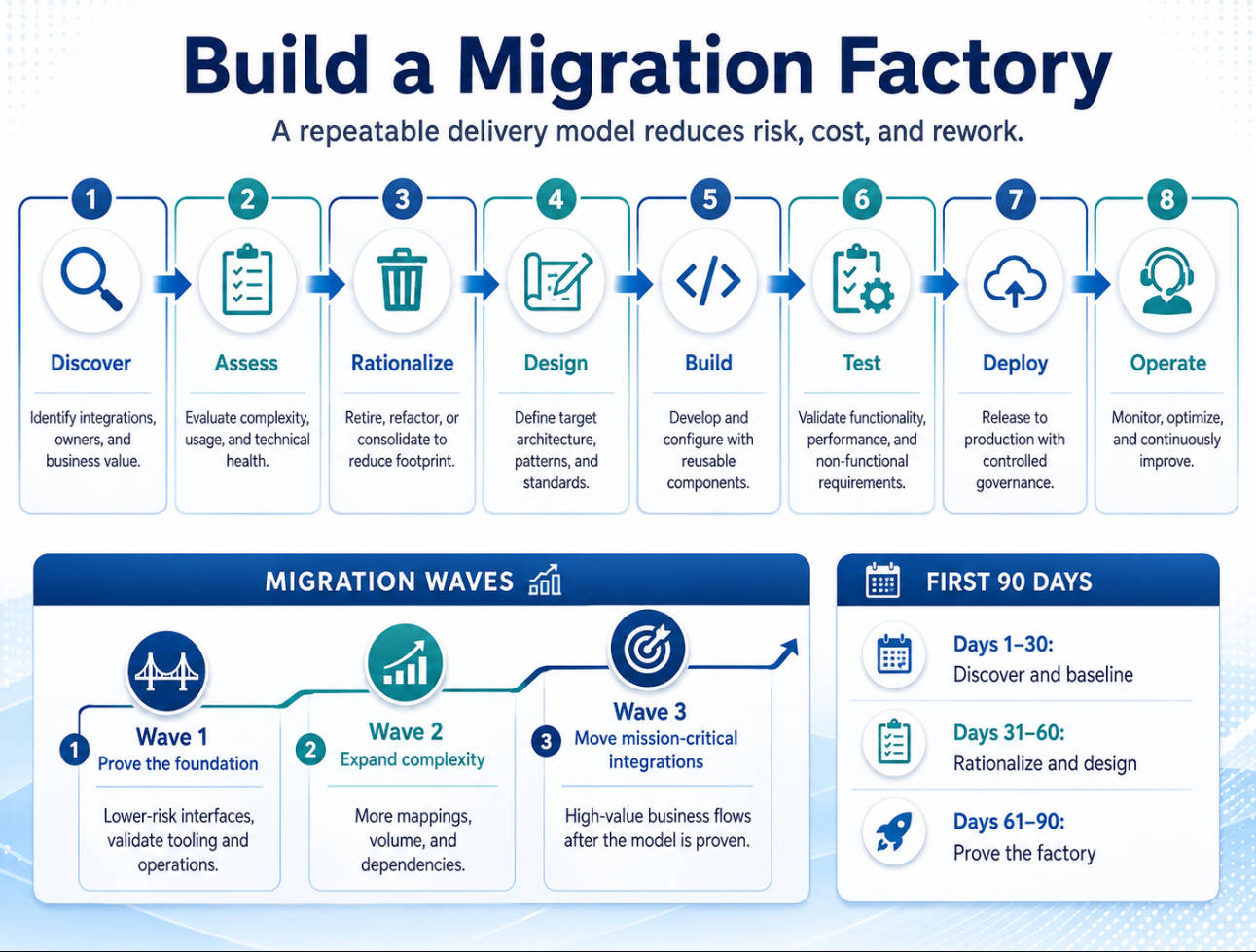 The goal is repeatability. Every integration should enter through a consistent intake process. Every one should be assessed against the same architectural standards. Every migration should follow the same testing discipline. Every deployment should pass through the same DevSecOps controls.
This kind of factory model creates predictability around schedule, cost, quality, and risk. It also gives the organization a mechanism for learning. As each migration wave is completed, lessons can be incorporated into standards, automation, testing, and estimation.
Migrate in Waves and Use the Early Work to Prove the Model
Organizations should avoid starting with the most complex or mission-critical integration in the landscape.
The first wave should contain relatively straightforward, lower-risk scenarios. The objective is not simply to move a handful of interfaces. It is to validate connectivity, security, transport processes, logging, monitoring, error handling, certificate management, deployment controls, and operational procedures. In other words, the early integrations are used to test the migration factory itself.
The second wave can introduce greater complexity, including more sophisticated mappings, multiple endpoints, higher transaction volumes, and stronger business dependencies. At this stage, the program should begin to understand true migration velocity, where bottlenecks exist, and which activities can be standardized or automated.
Mission-critical integrations should come later, once the technical architecture and operating model are proven. By then, the migration program should function more like an established delivery capability than an experiment.
Automation Should Extend Beyond Artifact Conversion
SAP’s migration tooling can accelerate the conversion of supported PO artifacts, but organizations should think more broadly about automation.
The migration factory itself is a strong candidate for automation. Interface inventory collection, complexity classification, code and configuration checks, deployment pipelines, regression testing, security scanning, documentation generation, configuration validation, and cut-over readiness activities can all potentially be automated to varying degrees.
That matters because large migration programs quickly become repetitive. If hundreds or thousands of integrations are involved, every manual step multiplies into substantial cost and schedule impact.
This is also where DevSecOps becomes central to the operating model.
Integration development should be treated as software engineering. Changes should be version controlled. Deployment pipelines should move validated artifacts through environments. Testing should occur continuously, not only before production. Security checks should be embedded into the delivery lifecycle. The result is not simply a faster migration. It is a more sustainable development and operations model after migration is complete.
Automated Conversion Does Not Replace Engineering Judgment
Migration tools can save significant time, but organizations should be careful not to confuse automated conversion with successful modernization. A migration utility can translate supported technical artifacts. It cannot determine whether an interface should still exist. It cannot decide whether a business process would be better served by an API or an event. It cannot determine whether several point-to-point interfaces should become a reusable enterprise service.
Those decisions require architectural and engineering judgment.
The same is true for custom Java mappings, unusual adapters, BPM processes, custom protocols, and highly specialized integration logic. These scenarios may require redesign rather than conversion. The value of the assessment phase is that these complexities are identified early, when the organization can plan around them, rather than discovering them midway through development.
Testing Has to Validate the Business Process
Integration testing is sometimes treated too narrowly. A message leaves the source. Integration Suite processes it. The target receives it. The test is declared successful. But an interface can successfully transmit a message while still producing the wrong business outcome.
Migration testing therefore needs to validate business semantics as well as technical connectivity.
The organization should verify mappings, end-to-end business flows, failure scenarios, transaction volumes, security behavior, performance, exception handling, and recovery processes. Where practical, the same transaction set should be processed through both the existing PO implementation and the new Integration Suite flow so that outputs and business behavior can be compared directly. For large migration programs, automated regression testing can become one of the most valuable investments in the program because it reduces the amount of repetitive manual validation required across each successive migration wave.
Day-Two Operations Need to Be Designed Before Cut-over
The new Integration Suite environment eventually becomes someone’s production responsibility. That operating model should be designed during the migration, not after the technical work is complete.
Organizations with mature PO environments already have operational practices around failed messages, application outages, reprocessing, connectivity problems, certificate expiration, incident escalation, and production support. Those responsibilities do not disappear simply because the integration platform moves to the cloud.
The new operating model needs to establish clear ownership for integration monitoring, API governance, certificate management, production support, reusable integration components, deployment controls, alerting, and incident triage.
Without those decisions, organizations risk completing a technically successful migration only to discover that the new environment is harder to operate consistently than the old one.
Measure Modernization, Not Just Migration Progress
Every migration program eventually needs a dashboard, and the easiest metric is usually the number of interfaces migrated. That number is useful, but it can also be misleading. If an organization begins with 1,500 PO interfaces and ends with 1,500 nearly identical Integration Suite flows, the migration may be technically complete but architecturally disappointing.
A stronger program also measures how much complexity it eliminated.
That could mean tracking how many obsolete interfaces were retired, how many duplicate connections were consolidated, how much custom code was removed, how many reusable APIs or integration components were created, how many manual deployment activities were automated, and whether integration incidents or development cycle times improved.
Those measures reveal whether the organization actually modernized the integration environment.
What the First 90 Days Should Accomplish
For an organization beginning the transition today, the first 90 days should focus on establishing facts, architecture, and repeatability rather than immediately attempting a large-volume migration.
During the first month, the organization should build an accurate inventory of the PO landscape, run migration assessments, identify application and business owners, analyze mappings and custom code, understand transaction volumes, and identify integrations connected to applications that are already scheduled for replacement or retirement.
The second month should focus on rationalization and architecture. Interfaces should be classified according to whether they should be retired, migrated, refactored, or modernized. At the same time, the organization should establish the target integration architecture, define security and DevSecOps standards, determine how APIs and event-driven integration will be governed, and group the integration portfolio into logical migration waves.
The third month should be used to prove the approach in practice. A representative group of pilot integrations should be migrated. Deployment pipelines and transport processes should be exercised. Testing and monitoring procedures should be validated. Lessons learned should be captured and used to refine the broader migration estimate and wave plan.
At the end of 90 days, the organization should have considerably more than a strategy document. It should have a functioning migration model and evidence that the model works.
Summary
So then what is the real goal? The Real Goal Is Integration Simplification
The transition from SAP Process Orchestration to SAP Integration Suite creates a rare architectural opportunity. Organizations are already being forced to inspect integration landscapes that may have accumulated technical debt for years. That inspection should not end with a one-for-one migration plan.
It should produce a better architecture.
The strongest programs will combine migration with integration rationalization, API governance, event-driven architecture, automation, DevSecOps, clean-core principles, and S/4HANA modernization. They will use automated migration where it makes sense and engineering judgment where it does not. And they will measure success not only by how quickly SAP PO is turned off, but by how much simpler, more reusable, more governable, and more adaptable the integration environment becomes.
That is the difference between replacing middleware and modernizing the enterprise.
For SAP customers facing the transition from Process Orchestration, the question is therefore not simply: How do we migrate from SAP PO to Integration Suite?
The more valuable question is: What integration architecture do we want to be operating for the next decade?