

 Anthony Cecchini is the President and CTO of Information Technology Partners (ITP), an ERP technology consulting company headquartered now in Virginia, with offices in Herndon. ITP offers comprehensive planning, resource allocation, implementation, upgrade, and training assistance to companies. Anthony has over 25 years of experience in SAP business process analysis and SAP systems integration. ITP is a Silver Partner with SAP, as well as an Appian, Pegasystems, and UIPath Low-code and RPA Value Added Service Partner. You can reach him at [email protected].
For decades, achieving a clean financial audit has remained one of the Department of Defense’s most persistent management challenges. Each fiscal year brings extensive preparation, documentation requests, transaction testing, reconciliation efforts, and remediation activities involving financial management professionals across military departments, defense agencies, and supporting organizations. Despite substantial investments in enterprise resource planning (ERP) systems, financial improvement initiatives, and business process modernization, the Department continues to face significant challenges in demonstrating the accuracy, completeness, and reliability of its financial statements. These difficulties reflect more than the sheer size of the Department’s financial operations. They also reveal longstanding problems with fragmented enterprise systems, inconsistent financial data, ineffective internal controls, and business processes that frequently require extensive manual intervention.
The magnitude of the challenge is difficult to overstate. In fiscal year 2025, the Department received another disclaimer of opinion on its agency-wide financial statements, meaning auditors could not obtain sufficient, appropriate evidence to express an audit opinion. With approximately $4.6 trillion in reported assets, DoD operates within an extraordinarily complex financial environment encompassing procurement, logistics, personnel, property management, and mission-support activities around the world. Although several DoD reporting entities have achieved clean audit opinions, persistent weaknesses in financial systems, transaction documentation, asset accountability, and internal controls continue to complicate Department-wide audit efforts. Addressing these weaknesses requires sustained attention to the processes and technologies that generate financial information, not simply additional resources dedicated to preparing for an annual audit.
The next phase of DoD audit readiness should therefore be defined by a fundamental change in approach. Rather than concentrating primarily on preparing documentation, reconciling accounts, and resolving discrepancies during scheduled audit periods, the Department has an opportunity to establish financial environments in which transactions are validated, controls are monitored, and supporting evidence is maintained throughout normal business operations. This model, commonly described as continuous financial assurance, would make financial accountability a routine function of enterprise operations rather than a recurring exercise in reconstructing historical activity. Achieving that objective requires the coordinated application of automation, trusted financial data, enterprise integration, and effective internal control governance.
Why the Traditional Audit Readiness Model Falls Short 
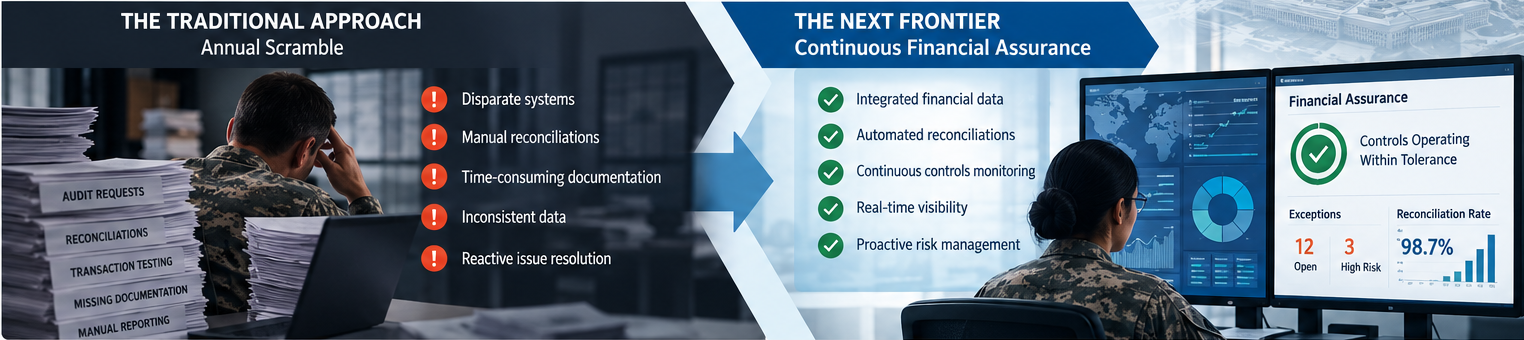
Traditional audit preparation frequently concentrates substantial resources around reporting deadlines and scheduled audit procedures. Financial management teams assemble supporting documentation, investigate differences between accounting systems, trace transactions through multiple applications, and respond to requests for additional evidence. While these activities are necessary, they become particularly labor-intensive when financial systems do not consistently produce complete, accurate, and accessible information. Personnel can spend considerable time reconstructing transaction histories rather than investigating the underlying causes of financial control weaknesses.
Consider a typical defense procurement transaction. An obligation may originate in an acquisition application, move through a logistics or receiving system, be recorded in an ERP platform, and ultimately appear in a financial reporting environment. Each application may maintain different transaction identifiers, accounting structures, approval workflows, and supporting documentation. When these systems are not adequately integrated, financial personnel must manually establish whether the obligation was properly recorded, goods or services were received, invoices matched authorized purchases, and payments were accurately reflected in the general ledger. Multiply these activities across millions of transactions, and the operational burden becomes substantial.
The underlying problem is not simply inefficient audit preparation. Many financial processes were never designed to generate complete, traceable evidence automatically as transactions occur. Organizations consequently rely on retrospective verification to demonstrate that financial activity was properly authorized, processed, and recorded. Although additional staffing and improved documentation procedures can help address immediate audit requirements, they do not necessarily correct the architectural and process weaknesses that create recurring reconciliation problems.
A more sustainable approach requires bringing financial assurance closer to the point where transactions originate. Instead of repeatedly reconstructing historical activity, agencies can design business processes and supporting systems to validate transactions, identify discrepancies, and preserve evidence throughout the financial lifecycle.
From Periodic Reconciliation to Transaction-Level Assurance
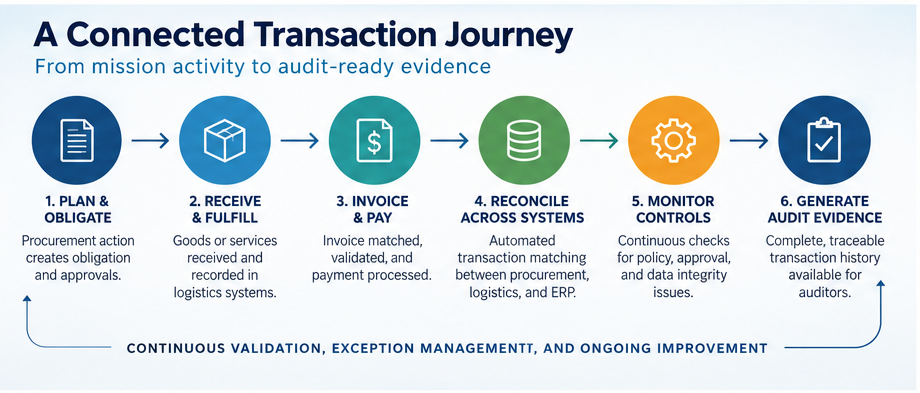
One of the most promising opportunities for improving DoD audit readiness is the automation of transaction-level reconciliation, a fundamental financial control process that has traditionally required considerable manual effort. Financial management organizations routinely compare records from different systems to identify discrepancies, investigate their causes, and correct errors before they affect financial reporting. In complex defense environments, however, these activities can involve enormous transaction volumes, inconsistent source information, and exceptions requiring extensive coordination across multiple organizations. The challenge becomes particularly significant when procurement, logistics, accounting, and payment systems operate independently, forcing personnel to reconstruct transaction histories across applications that were not designed to exchange information seamlessly.
Modern integration and automation technologies offer an opportunity to change how these reconciliations are performed. Rather than waiting until month-end or year-end to identify discrepancies, agencies can establish automated reconciliation processes that operate as transactions move between enterprise systems. An integrated financial assurance workflow could compare procurement obligations against corresponding receiving records, invoices, disbursements, and general ledger entries, verifying that each transaction satisfies established business and accounting rules. Transactions meeting those requirements could be documented automatically, while discrepancies would be identified and routed to appropriate financial personnel for investigation. This approach would allow organizations to recognize potential problems earlier, before they accumulate into significant reconciliation backlogs.
The potential applications extend beyond basic transaction matching. Automated checks could identify duplicate payments, unmatched obligations, inconsistent accounting classifications, missing receiving documentation, or transactions that violate established approval requirements. By continuously examining financial activity across integrated systems, agencies can detect patterns that might otherwise remain unnoticed until a scheduled reconciliation or external audit. These capabilities can also strengthen accountability by maintaining records of transactions evaluated, exceptions identified, personnel assigned to investigate them, and corrective actions completed.
Over time, this information becomes valuable for improving the underlying business processes themselves. If automated reconciliation repeatedly identifies discrepancies associated with a particular interface, accounting classification, or receiving process, management can investigate the root cause rather than continually correcting individual transactions. This creates an opportunity to move beyond processing exceptions toward reducing the conditions that generate them.
Effective automation, however, requires considerably more than comparing dollar amounts or connecting databases. Reliable transaction-level assurance depends on validated identifiers, authoritative source data, appropriate timing tolerances, documented reconciliation logic, and clearly defined exception-handling procedures. An unmatched transaction may reflect a legitimate timing difference between receiving and payment activities rather than an accounting error. Automated processes must recognize these distinctions and preserve the ability of financial professionals to exercise judgment when circumstances require further investigation.
The objective is not to eliminate financial oversight but to make it more effective. By reducing repetitive manual activities and directing professional attention toward exceptions, root causes, and higher-risk decisions, automated reconciliation can improve both operational efficiency and the consistency of evidence supporting financial assertions.
Continuous Controls Monitoring: Moving from Detection to Prevention
Accurate transaction records alone do not establish financial auditability. Agencies must also demonstrate that effective internal controls govern how transactions are authorized, processed, recorded, and safeguarded. Historically, organizations have often relied on periodic control testing, manual certifications, and retrospective reviews to determine whether those controls operated as intended. Continuous controls monitoring offers an opportunity to strengthen this model by evaluating defined control conditions throughout normal business operations rather than relying primarily on periodic examination.
For example, automated monitoring could identify users with conflicting financial system responsibilities, approvals occurring outside established authority thresholds, transactions bypassing required workflow steps, or privileged access remaining active beyond authorized periods. Additional routines might examine vendor master data changes, unusual payment patterns, journal entries requiring further review, or transactions lacking required documentation. When integrated with workflow management capabilities, these monitoring activities can automatically notify designated control owners, assign corrective actions, and preserve records of how identified exceptions were addressed.
The value of this approach extends beyond detecting individual control violations. Continuous monitoring can reveal recurring weaknesses that suggest broader problems with business processes, system configuration, or personnel training. A pattern of unauthorized approval attempts, for instance, may indicate that an established workflow no longer reflects operational responsibilities. Repeated documentation deficiencies might reveal that an upstream application is failing to preserve required records. By analyzing these patterns over time, management can address systemic weaknesses before they contribute to significant audit findings.
However, continuous monitoring should not be confused with automatic assurance that internal controls are effective. Monitoring logic must be appropriately designed, tested, maintained, and supported by reliable information. Agencies must establish ownership for exceptions, document corrective actions, and validate whether automated controls actually address the financial reporting risks they were designed to mitigate. Technology can make control monitoring more consistent and timely, but effective financial governance still depends on accountable personnel, documented procedures, and independent evaluation.
Integrated Financial Data: The Foundation of Continuous Assurance
Automation and continuous monitoring cannot compensate for fundamentally unreliable financial information. Across DoD, financial data is distributed among ERP platforms, legacy accounting applications, acquisition systems, logistics environments, and specialized mission-support solutions. Many of these systems were developed at different times to address distinct operational requirements, creating an enterprise environment in which information may be duplicated, inconsistently classified, or difficult to trace across organizational boundaries. Even when individual applications function correctly, weaknesses in data integration can undermine the completeness and consistency of financial reporting.
Building continuous financial assurance therefore requires a deliberate enterprise data strategy that establishes common definitions for critical financial information, identifies authoritative sources, and preserves relationships between transactions as they move through different systems. Obligation records, purchase orders, inventory receipts, disbursements, and accounting entries must remain traceable even when the applications maintaining them use different identifiers or data structures. Application programming interfaces (APIs), governed data integration platforms, automated validation routines, and standardized data models can help establish these relationships.
Importantly, the objective should not necessarily be to replace every existing financial application. In many cases, modernization will require integrating legacy environments with newer enterprise platforms while progressively addressing redundant systems, inconsistent data structures, and high-risk interfaces. An agency may have a modern ERP system at the center of its financial architecture but continue to depend on specialized applications for procurement, logistics, or mission-specific transactions. Establishing reliable data exchange between those applications is essential to maintaining financial accountability across the complete business process.
This challenge is particularly relevant to large-scale SAP environments and other defense ERP modernization programs. Modern ERP platforms can standardize financial processes, improve reporting capabilities, and strengthen enterprise visibility, but their effectiveness depends heavily on the quality of incoming information and the integration architecture surrounding them. A consolidated dashboard may provide executives with an improved view of obligations, expenditures, and assets, yet it does not necessarily establish that underlying transactions are complete or accurate. Financial transparency ultimately depends on trusted source information, consistent accounting relationships, and the ability to trace reported balances back to supporting business activity.
The Emerging Role of Intelligent Automation and AI
Robotic process automation (RPA), workflow orchestration, advanced analytics, and artificial intelligence offer additional opportunities to strengthen financial management operations. RPA can support structured, repetitive activities such as retrieving records, comparing standardized information, gathering supporting documentation, and transferring data between applications that lack modern integration interfaces. Workflow platforms can coordinate reconciliation activities across organizational boundaries, assign exceptions to responsible personnel, track remediation deadlines, and maintain records of approvals and corrective actions. Advanced analytics can examine large transaction populations to identify unusual patterns, prioritize higher-risk exceptions, and help management understand recurring financial control deficiencies.
Artificial intelligence may further extend these capabilities by assisting with document classification, interpreting unstructured financial records, and identifying potential relationships between transactions. For example, an AI-assisted process could organize supporting documentation associated with a procurement transaction, identify potentially missing records, or help financial personnel locate relevant information across multiple applications. These applications could reduce administrative burden and accelerate the investigation of complex discrepancies, particularly where supporting information is distributed across structured databases and document repositories.
The introduction of AI into financial assurance nevertheless requires considerable discipline. AI-generated recommendations should not be treated as authoritative accounting conclusions, and any automated analysis used to support financial reporting must be evaluated for accuracy, completeness, and suitability within the organization’s control framework. Systems must preserve source references, maintain auditable transaction histories, protect sensitive financial information, and provide sufficient transparency for independent review. The most practical near-term opportunity is not autonomous financial decision-making but the combination of deterministic business rules, trusted data integration, intelligent exception management, and carefully governed AI assistance.
Why Continuous Financial Assurance Supports Mission Readiness
The benefits of improving financial accountability extend well beyond the annual audit. Reliable financial information directly affects the Department’s ability to allocate resources, manage acquisition programs, sustain equipment, oversee inventory, and make informed operational decisions. When financial records are incomplete or inconsistent, leaders may struggle to determine whether funds remain available, whether assets have been properly accounted for, or whether financial commitments accurately reflect mission requirements. These weaknesses can create delays, increase administrative costs, and reduce confidence in information used to support operational planning.
A mature continuous financial assurance capability can improve visibility into obligations, expenditures, asset values, and emerging financial risks throughout the fiscal year. Program managers can identify potential funding issues earlier, financial executives can evaluate resource execution using more reliable information, and logistics organizations can strengthen relationships between physical assets and financial records. Auditors benefit from better-organized supporting evidence and more consistent documentation of internal control activities, reducing the need to reconstruct transaction histories manually.
Ultimately, the value of financial modernization should be measured not only by improvements in audit results but also by the quality of information available to mission leaders. Stronger financial controls and more dependable transaction data support better stewardship of public resources while helping organizations make decisions with greater confidence.
Building a Practical Roadmap Toward Continuous Assurance
Achieving continuous financial assurance does not require agencies to attempt an immediate, enterprise-wide transformation. A practical approach begins by identifying financial processes that present significant audit risk, generate substantial transaction volumes, or consume considerable manual reconciliation effort. Organizations can then prioritize targeted improvements that deliver measurable benefits while establishing reusable integration patterns, automated controls, and exception-management capabilities. An initial effort might focus on reconciliations between procurement, receiving, and financial systems, while another could strengthen evidence collection for selected internal controls.
Each initiative should begin with a detailed understanding of the existing business process, authoritative data sources, system interfaces, control requirements, and operational responsibilities. Agencies must establish reliable data exchange, documented reconciliation rules, and appropriate exception-handling procedures before introducing more advanced automation or analytics. This foundational work is critical because automating an ineffective process can accelerate errors rather than improve financial accountability.
A phased implementation approach also creates opportunities to validate results before expanding automation across additional financial processes. Agencies can begin with a limited transaction population, evaluate matching accuracy and exception rates, resolve integration weaknesses, and refine operating procedures based on observed performance. As confidence in the process increases, the scope can expand to additional transaction types, systems, and organizational boundaries.
Performance should be measured through operational indicators that reflect genuine improvements in financial assurance. Relevant measures include reconciliation completion time, unresolved exception aging, evidence completeness, control failure rates, and the percentage of transactions supported by traceable documentation. These metrics provide a more meaningful measure of progress than simply counting automated workflows or completed integrations, because they demonstrate whether modernization is improving the quality and reliability of financial operations.
Sustained progress also requires collaboration among financial management organizations, system owners, cybersecurity teams, enterprise architects, and audit stakeholders. Continuous financial assurance is not solely a financial management initiative or an IT modernization project. It is a cross-functional transformation that must connect financial policy, system architecture, internal controls, and operational accountability.
Summary
The Department of Defense’s financial modernization journey remains a complex undertaking, and achieving a sustainable clean audit opinion will require continued improvements in business processes, enterprise systems, internal controls, and data reliability. No single technology platform, automation initiative, or modernization program will resolve every challenge. Meaningful progress will depend on disciplined implementation, consistent financial governance, and the ability to connect technical improvements with measurable financial management outcomes.
Nevertheless, the direction forward is clear. Rather than treating audit readiness primarily as an intensive annual effort to assemble and validate historical information, DoD organizations have an opportunity to build financial environments in which transactions are routinely reconciled, control exceptions are promptly investigated, and supporting evidence is systematically maintained throughout the year. This approach transforms audit readiness from a periodic compliance exercise into an enduring management capability that strengthens transparency, accountability, and operational decision-making.
Ultimately, the true measure of financial modernization success should extend beyond how efficiently an organization prepares for its next audit. It should reflect how confidently that organization can account for its resources, demonstrate effective financial controls, and provide mission leaders with reliable information every day of the year. That is the next frontier of DoD audit readiness: moving beyond annual scrambles toward continuous financial assurance and sustained mission confidence.