

 Anthony Cecchini is the President and CTO of Information Technology Partners (ITP), an ERP technology consulting company headquartered now in Virginia, with offices in Herndon. ITP offers comprehensive planning, resource allocation, implementation, upgrade, and training assistance to companies. Anthony has over 25 years of experience in SAP business process analysis and SAP systems integration. ITP is a Silver Partner with SAP, as well as an Appian, Pegasystems, and UIPath Low-code and RPA Value Added Service Partner. You can reach him at [email protected].
There was a time when inventory management was mostly a math problem.
Companies forecasted demand, calculated safety stock levels, negotiated supplier lead times, and tried to avoid two outcomes above all others: running out of product or carrying too much of it. If the warehouses stayed reasonably full and customers were mostly satisfied, leadership considered the operation successful.
That world is gone.
Today, inventory sits at the center of nearly every major business pressure facing the modern enterprise. Inflation changes purchasing behavior overnight. A shipping disruption on the other side of the world suddenly affects manufacturing schedules in North America. Demand spikes emerge from social media trends rather than predictable seasonal cycles. Customers expect near-immediate fulfillment, while finance departments pressure operations teams to reduce working capital exposure at the exact same time.
The problem is not simply that supply chains became more complicated. The deeper issue is that many organizations are still trying to manage modern volatility using operational models designed for a slower, more predictable era.
That is where SAP S/4HANA begins to change the story. Not because it makes reports run faster. Not because dashboards look more modern. And not because “digital transformation” has become a corporate slogan.
The real shift is much more fundamental. SAP S/4HANA changes how organizations see inventory itself.
Instead of treating inventory as a static asset sitting inside warehouses, the platform allows companies to treat inventory as a living, moving, constantly changing operational signal tied to procurement, manufacturing, logistics, finance, customer behavior, and risk. That sounds subtle on paper. Operationally, it changes almost everything.
Why Traditional ERP Environments Struggle 
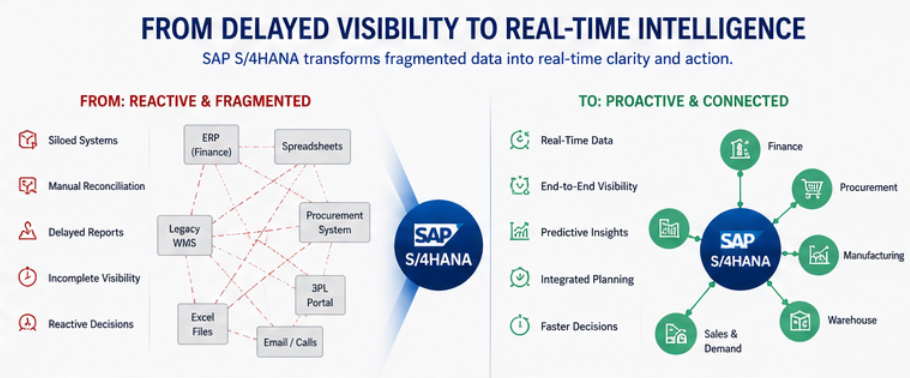
In traditional ERP environments, inventory planning often resembled archaeology.
Teams spent enormous amounts of time trying to understand what had already happened. Data was fragmented across warehouses, procurement systems, spreadsheets, transportation platforms, and disconnected reporting tools. By the time planners identified a trend, the business had usually already absorbed the impact.
A supplier delay became visible too late. A regional demand surge created stockouts before replenishment could react. Excess inventory quietly accumulated in the wrong locations while another facility experienced shortages.
Most organizations compensated for this uncertainty the same way: by carrying more inventory.
- More buffer stock.
- More safety stock.
- More “just in case” inventory.
It worked, at least temporarily, because excess inventory masked operational blind spots.
But carrying inventory has become dramatically more expensive. Warehousing costs continue to rise. Capital is tighter. Supply chain complexity is increasing. Executive leadership wants resilience without bloated operating costs.
The old approach no longer scales.
What SAP S/4HANA introduces is the ability to operate against live operational reality instead of delayed historical snapshots.
Real-Time Visibility Changes Operational Behavior
Imagine a planner sitting inside a manufacturing organization.
In older systems, identifying an inventory issue might require pulling reports from multiple applications, reconciling spreadsheets, contacting suppliers manually, and waiting for overnight batch jobs to refresh operational data. Every decision carried latency.
In SAP S/4HANA, much of that operational delay begins to disappear.
The planner can see inventory positions changing in real time. Supplier disruptions become visible earlier. Demand fluctuations appear faster. Procurement, logistics, warehouse operations, and financial implications exist inside the same operational environment rather than scattered across disconnected systems.
That shift compresses decision-making timelines dramatically.
And that compression matters because modern supply chains increasingly reward speed more than perfection.
Organizations rarely fail because they made one catastrophic inventory decision. More often, they fail because they reacted too slowly to hundreds of smaller changes happening simultaneously across the enterprise.
What makes SAP S/4HANA powerful is not simply that it processes data faster. It creates operational awareness earlier.
That difference becomes increasingly important in volatile markets.
Inventory Is Becoming a Financial Strategy
There is another change happening beneath the surface that many organizations underestimate.
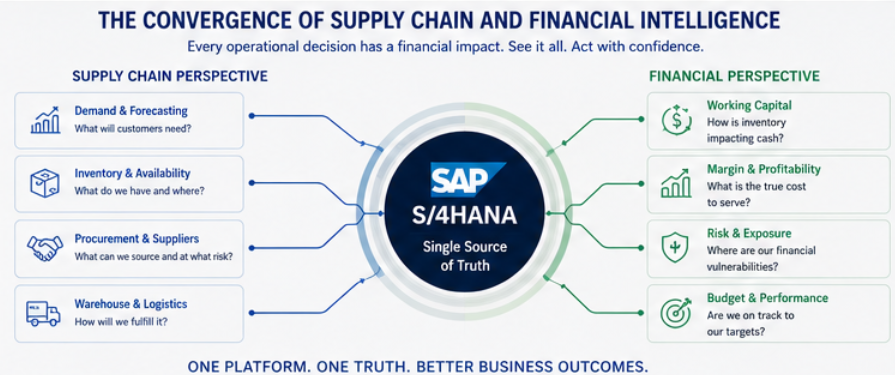
Historically, inventory optimization was treated as a supply chain responsibility. Finance monitored carrying costs, but inventory planning itself largely remained operational.
Today, finance and operations are becoming inseparable.
Every inventory decision affects working capital.
Every shortage affects revenue.
Every fulfillment delay affects customer retention.
Every excess purchase affects margin performance.
In many companies, supply chain teams and finance teams still operate from different realities. One side sees operational constraints. The other sees balance sheet exposure.
SAP S/4HANA begins to close that gap by integrating operational and financial visibility into the same environment.
A procurement decision no longer exists in isolation.
A manufacturing delay is not merely a scheduling issue.
A slow-moving inventory trend is not just a warehouse concern.
Each operational event immediately carries financial context.
That alignment changes executive behavior because inventory stops being viewed purely as a logistics discussion. It becomes part of enterprise strategy.
The Shift from Efficiency to Resilience
The organizations seeing the greatest value from SAP S/4HANA are often not the ones merely trying to modernize technology.
They are the ones rethinking operational philosophy.
For years, many supply chains were optimized primarily for efficiency. Lean inventory models reduced carrying costs and minimized waste. Under stable conditions, the strategy worked extremely well.
But recent global disruptions exposed a weakness in that thinking.
A supply chain optimized only for efficiency can become fragile. Suddenly, resilience mattered as much as cost reduction.
Companies realized that the lowest inventory position was not always the best inventory position. They needed the ability to model disruption, understand exposure, evaluate supplier risk, and rebalance operations quickly when conditions changed.
This is where real-time ERP capabilities become strategically important. SAP S/4HANA allows organizations to simulate scenarios and adjust operations with far greater agility than legacy environments.
What happens if a supplier fails?
What happens if transportation capacity tightens?
What happens if demand unexpectedly doubles in one region?
What happens if a manufacturing facility slows production?
The faster an organization can answer those questions, the more resilient it becomes. And resilience is increasingly becoming a competitive differentiator.
The Planner’s Role Is Changing
One of the most interesting shifts happening inside modern ERP environments is the changing role of the planner.
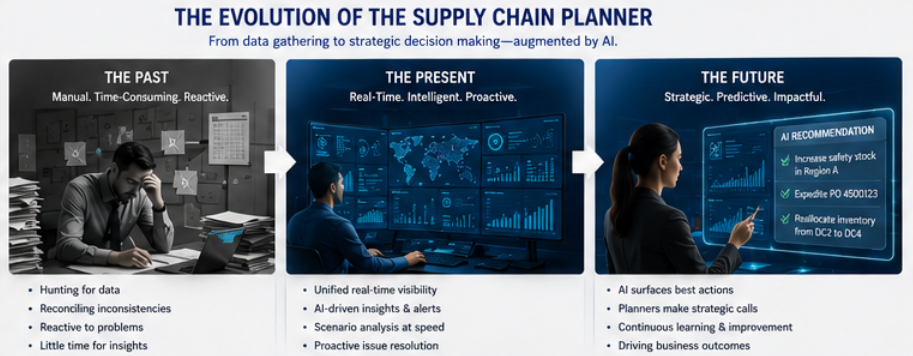
In older operational models, planners often acted as human data integrators. Large portions of their day were spent gathering information, validating reports, reconciling inconsistencies, and manually coordinating responses between disconnected departments.
That work created operational drag.
Modern platforms increasingly automate portions of that process through embedded analytics, predictive modeling, and machine learning-assisted planning.
The planner’s role begins to evolve.
Instead of spending hours assembling information, they spend more time interpreting patterns, evaluating tradeoffs, and making strategic operational decisions.
That distinction matters because supply chains are becoming too dynamic for humans to manually process every operational variable fast enough.
The future is not fully autonomous supply chains replacing human judgment. The future is intelligent systems reducing friction so human expertise can operate at a higher level.
Warehouses Are Becoming Intelligent Operational Hubs
Warehouse operations are evolving as well.
For decades, warehouses were often treated as downstream execution environments. Inventory planning happened somewhere else, while warehouse teams focused on receiving, storing, and shipping products.
But as fulfillment expectations accelerate, warehouse operations increasingly become part of strategic inventory optimization itself.
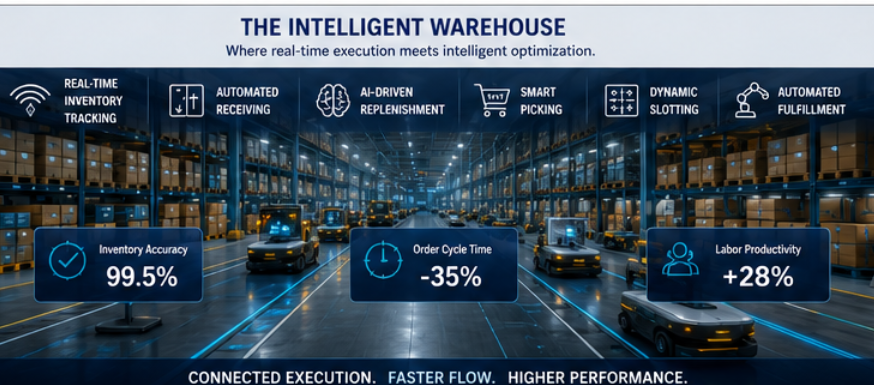
Inventory visibility means very little if physical execution cannot keep pace.
SAP’s broader ecosystem capabilities around warehouse management and logistics integration help synchronize planning with execution in ways that older environments struggled to achieve.
When warehouse execution, procurement, transportation, and inventory planning operate together inside a connected operational architecture, organizations gain the ability to respond much faster to changing conditions.
That synchronization becomes especially important as companies pursue automation, robotics, predictive replenishment, and AI-assisted fulfillment operations.
The warehouse is no longer just a storage facility. It is becoming an intelligent operational node inside a continuously adapting supply network.
ERP Systems Are Evolving into Decision Platforms
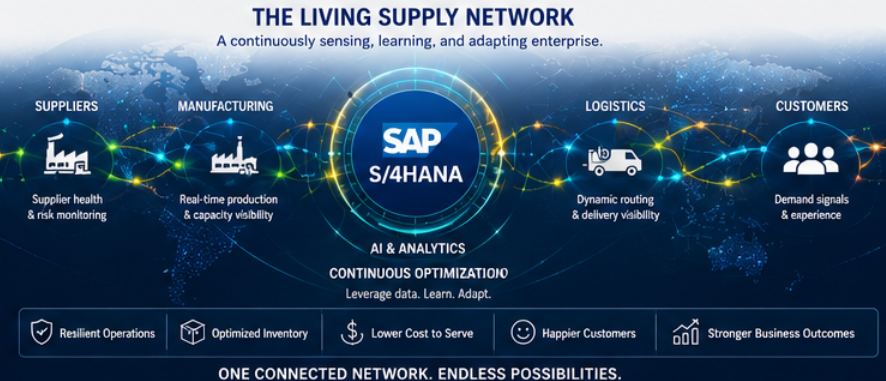
There is also a larger shift happening across enterprise technology itself. ERP systems were once designed primarily to record transactions. Now they are increasingly expected to guide decisions.
That transition may ultimately become one of the defining characteristics of the next generation of enterprise operations.
Organizations no longer want systems that merely tell them what happened yesterday. They want platforms capable of helping them understand what is happening right now and what is likely to happen next.
Inventory optimization sits directly in the middle of that transformation because inventory reflects the health of the entire enterprise.
When forecasting weakens, inventory reveals it.
When suppliers struggle, inventory reveals it.
When customer behavior changes, inventory reveals it.
When operations lose synchronization, inventory reveals it.
Inventory is no longer just product sitting on shelves. It is operational intelligence.
Summary
The real story behind inventory optimization in the SAP S/4HANA era is not about counting products faster or producing more sophisticated reports.
It is about building organizations capable of sensing change earlier, responding faster, and operating with greater confidence in increasingly volatile environments.
Companies that continue relying on fragmented inventory processes will struggle to keep pace with accelerating market complexity. The operational delays that once seemed manageable now create financial exposure, customer dissatisfaction, and strategic risk.
SAP S/4HANA represents a different operational model. One where inventory, finance, procurement, logistics, warehouse operations, and analytics operate together in real time instead of existing as disconnected business functions.
That convergence changes how organizations make decisions.
It changes how they manage risk.
It changes how they respond to disruption.
And ultimately, it changes how they compete.
Inventory optimization is no longer simply a supply chain initiative. It is becoming one of the foundational capabilities of the intelligent enterprise.