

 Anthony Cecchini is the President and CTO of Information Technology Partners (ITP), an ERP technology consulting company headquartered now in Virginia, with offices in Herndon. ITP offers comprehensive planning, resource allocation, implementation, upgrade, and training assistance to companies. Anthony has over 25 years of experience in SAP business process analysis and SAP systems integration. ITP is a Silver Partner with SAP, as well as an Appian, Pegasystems, and UIPath Low-code and RPA Value Added Service Partner. You can reach him at [email protected].
The Army’s decision to rethink ERP consolidation may create a better path to S/4HANA modernization, enterprise-wide data integration, and a more agile business environment. When the Army decided in May 2026 not to exercise the next option year on Enterprise Business Systems Convergence (EBS-C) contract, it raised some important questions about the future of Army ERP modernization.
The original vision was ambitious. Consolidate the Army’s major financial and logistics systems into a single, modernized SAP S/4HANA environment. Replace years of fragmented business processes, eliminate redundant infrastructure, standardize data, and provide a more consistent experience for soldiers and civilian personnel. The objectives made sense. The challenge was how to get there.
Anyone who has worked with large SAP environments understands that consolidating multiple mature ERP systems is much more complicated than moving data from one system to another. Each environment has its own business processes, configuration, custom code, interfaces, security requirements, and operational dependencies. Trying to consolidate all of that while simultaneously transitioning to S/4HANA introduces enormous complexity.
Could this decision creates an opportunity to approach the problem differently? What if rather than consolidate first and modernize second, the Army modernized each ERP independently, establish a common enterprise architecture, and then consolidate when the systems are actually ready?
I believe this approach could significantly reduce risk while delivering many of the benefits EBS-C was originally intended to achieve.
The Army Still Needs to Modernize 
The decision not to continue the original consolidation contract does not eliminate the underlying problem. The Army’s ERP systems still need modernization.
GFEBS, GCSS-Army, and LMP serve different operational missions, but they share a common SAP technology foundation. They also face many of the same challenges, including aging software, technical debt, increasingly complex integrations, cybersecurity requirements, and the need for better access to enterprise data.
There is also the SAP maintenance timeline. Mainstream maintenance for qualifying SAP ECC 6.0 releases ends December 31, 2027, with optional extended maintenance available through 2030. This does not mean every Army system must complete its migration by the end of 2027, but it does make a sustainable modernization strategy increasingly important.
The Army has already taken steps toward unified ERP management and sustainment through its Consolidated ERP organization and Shared Services Center. In fact, its 2026 industry briefing identified sustaining current ERP systems, reducing sustainment costs, maintaining audit readiness, and modernizing applications and SAP cores as major priorities.
These priorities remain relevant regardless of whether the Army ultimately operates one ERP system or several.
The question is no longer simply how to replace the existing systems. It is how to modernize them without disrupting the missions they support.
Modernize Each ERP on Its Own Timeline
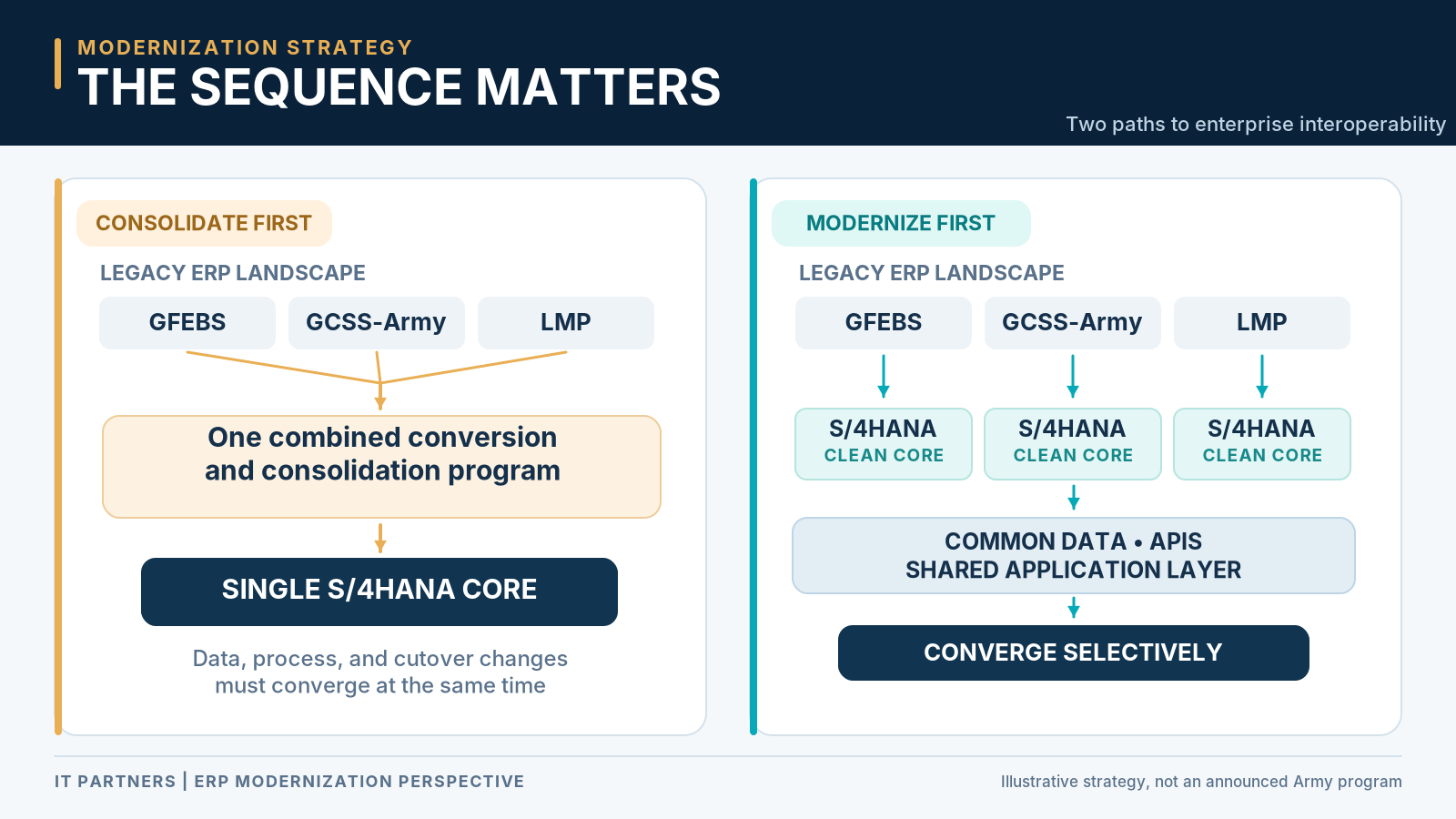
It could start by allowing each Army ERP program to modernize its SAP environment according to its operational requirements, technical condition, and mission priorities.
GFEBS supports financial management. GCSS-Army supports tactical logistics. LMP supports national-level logistics and industrial operations. These systems have different users, business processes, and operational constraints. Their modernization schedules should reflect those differences. Instead of forcing all three through a single transformation schedule, each program could develop its own S/4HANA transition plan under a common Army enterprise architecture.
That distinction is important. I am not suggesting three independent modernization programs with no coordination. I am suggesting separate technical migrations governed by common enterprise standards. Each program would have an opportunity to examine its business processes, eliminate unnecessary customization, simplify its SAP configuration, remediate data, and determine which capabilities should remain in the ERP. This would also provide an opportunity to eliminate functionality that no longer serves a useful purpose.
Over time, large ERP environments tend to accumulate custom code, interfaces, reports, and specialized workflows. Some remain mission-critical. Others exist because of historical requirements, older software limitations, or business processes that have long since changed. An S/4HANA conversion should not simply carry all of that forward. It should be an opportunity to simplify the environment and reduce the amount of technology the Army must maintain.
Establish the Common Data Model Before the Migrations
This is where I believe the real opportunity exists…
One of the major objectives of EBS-C was to create a more consistent enterprise data environment. That objective does not require the Army to begin with a single physical ERP instance. S/4HANA provides a modernized SAP data architecture, but migrating three systems to S/4HANA will not automatically make their business data consistent. Different programs may still use different organizational structures, material definitions, financial classifications, and master-data standards. Even when two systems use the same SAP data objects, they may interpret the underlying business information differently. If those differences are not addressed during modernization, they will remain obstacles to future consolidation.
I would establish a common Army enterprise data model before the individual S/4HANA migrations begin. This would include common definitions for shared business objects, data ownership, master-data governance, integration standards, and rules for synchronizing information across systems. Not every data element needs to be identical. Some differences are necessary because of mission requirements. The objective should be to standardize what is common and explicitly manage what must remain different.
Each ERP program could then align its migration with that enterprise model, progressively reducing the differences between the environments. By the time the Army considers physical consolidation, much of the difficult data analysis and harmonization work would already have been completed.
That is a substantially better starting point than attempting to resolve every data conflict during one massive conversion.
A Clean SAP Core Changes the Equation
The second major opportunity is the clean-core approach with an ERP First mindset.
Historically, large SAP implementations frequently placed significant amounts of custom functionality directly inside the ERP environment. While this approach addressed specific business requirements, it also made upgrades more complicated and expensive. Every major upgrade required organizations to evaluate custom code, resolve compatibility issues, retest interfaces, and ensure that modifications continued to function.
A modern S/4HANA architecture provides an opportunity to change that relationship. EBS-C already had an agility layer or customer facing layer in the design. At a high level the transactional ERP should remain responsible for the business functions it performs best, including financial accounting, procurement, inventory management, and other core transactions. Capabilities that do not need to reside inside the SAP core can be implemented through approved APIs, side-by-side extensions, and external application platforms. This does not mean removing every customization from SAP. Some business logic belongs inside the transactional environment, and SAP supports clean-core-compliant extensions. The objective is to eliminate unnecessary modifications and reduce the dependencies that make future upgrades difficult.
Consider a logistics workflow that requires information from multiple Army systems, routes an action for approval, and ultimately creates a purchase requisition in SAP. The workflow does not necessarily need to be coded inside SAP. An external application could coordinate the process, while the actual procurement transaction remains governed and recorded in S/4HANA. This separation makes the ERP easier to maintain while allowing the Army to modernize user-facing capabilities much more quickly.
It also becomes particularly valuable when several ERP systems must operate together.
The Palantir Enterprise Agreement Creates Another Opportunity
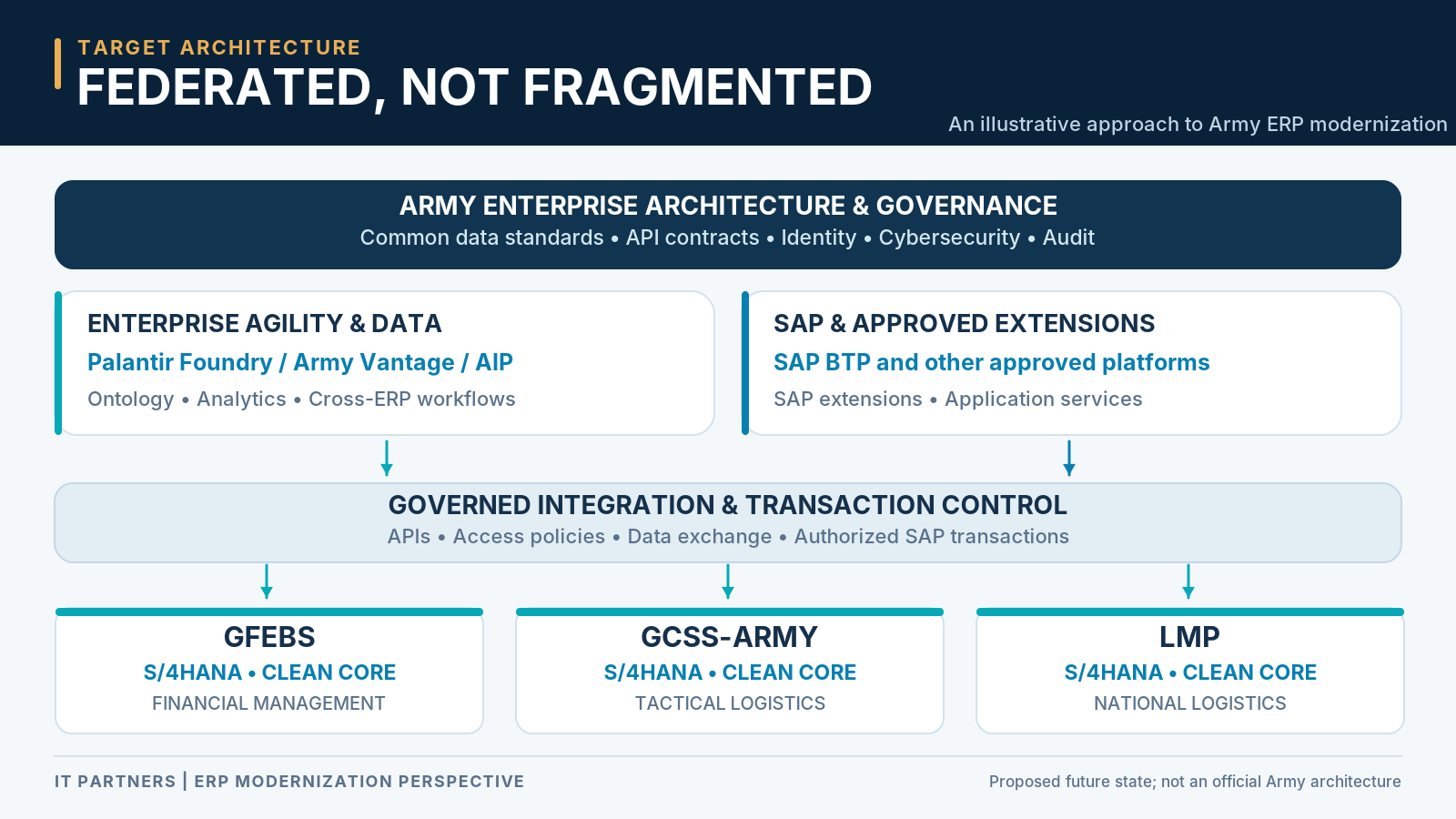
The Army’s enterprise agreement with Palantir introduces another potentially important architectural element.
In July 2025, the Army announced an enterprise agreement covering up to ten years, with a $10 billion contract ceiling, consolidating 75 contracts and providing streamlined access to Palantir’s commercial software, data integration, analytics, and AI capabilities. The agreement does not commit the Army to spending $10 billion, nor does it require every Army application to use Palantir. Nevertheless, it gives the Army an established enterprise vehicle for capabilities that could support this modernization strategy.
Palantir Foundry, including its ontology and application capabilities, could provide a common data and operational layer across multiple SAP environments. Instead of developing separate applications against each ERP, the Army could build shared capabilities that access information from GFEBS, GCSS-Army, and LMP through governed interfaces. For example, a common logistics application might combine inventory availability, procurement status, funding information, and operational requirements into a single user experience. The user would not necessarily need to know which ERP system holds each piece of information. The application could access the appropriate systems, coordinate the workflow, and execute authorized transactions through SAP interfaces. This approach also creates opportunities for AI-driven decision support, intelligent automation, predictive analytics, and cross-system workflows. There is already technical support for this type of integration. Palantir’s SAP connectors support ECC and S/4HANA environments, including controlled transactional writeback using SAP application interfaces.
However, I would be careful about making Palantir the destination for every SAP customization. SAP BTP and other approved application platforms still have important roles, particularly for extensions tightly coupled to SAP business processes. I would use Palantir where its enterprise data, ontology, analytics, and application capabilities provide the greatest value. The Army should also retain ownership of its data definitions, interfaces, and integration standards so that the architecture remains portable.
The important point is not the platform itself. It is the opportunity to separate the transactional systems from the applications and intelligence
One Enterprise Architecture, Multiple ERP Systems
For this strategy to work, the Army would need strong central architecture and governance.
I would retain a unified enterprise sustainment and architecture organization, while allowing individual ERP programs to control their mission-specific modernization requirements. Central governance should establish common standards for data, security, identity management, APIs, integration patterns, and technical architecture. It should also identify opportunities to share SAP technical services, infrastructure, monitoring, development pipelines, and other sustainment capabilities where practical. The individual ERP programs would remain responsible for their functional requirements, operational priorities, testing, and deployment decisions.
This is essentially a federated modernization approach. It provides the benefits of shared enterprise services without requiring every program to operate on the same implementation schedule. It also avoids recreating the fragmentation that enterprise consolidation was intended to solve.
Without common governance, three separate S/4HANA conversions could simply produce three modern but still disconnected ERP environments. In my opinion, that would represent significant investment without delivering the broader enterprise benefits.
The Army needs both elements: program-level execution and enterprise-level architectural discipline.
Would Consolidation Become Easier?
I believe it would, provided the Army establishes the common target architecture early and enforces it throughout the modernization process.
Imagine the Army several years from now. GFEBS, GCSS-Army, and LMP have completed their respective S/4HANA transitions. Their cores have been simplified, unnecessary customizations eliminated, and data structures aligned to common enterprise standards. Shared applications and workflows operate through an enterprise agility layer. Integration interfaces are standardized, business processes are better documented, and data ownership is clearly defined.
At that point, the Army would be in a much better position to evaluate whether consolidation makes sense.
There would still be substantial work involved. Different configurations, business processes, security boundaries, and mission requirements would have to be reconciled. Separate migrations followed by consolidation could also introduce additional conversion costs. For that reason, the Army should identify potential consolidation candidates early enough to avoid unnecessary duplication. But the complexity would be more manageable because the programs would no longer be starting from fundamentally different legacy architectures.
There is also a more interesting possibility…
What if the Army discovers that it no longer needs to consolidate every ERP into one system?
If the Army has modern S/4HANA environments, consistent enterprise data, common integration standards, and shared applications, it may already have achieved many of the outcomes EBS-C was designed to deliver. There may still be compelling reasons to consolidate particular functions or environments. Reduced infrastructure costs, common business processes, and lower sustainment expenses could justify that decision. But physical consolidation should be based on a measurable business case, not treated as the ultimate objective simply because it was part of the original strategy. The goal should be a more capable and efficient Army enterprise, not necessarily one SAP instance.
What I Would Prioritize in FY2027
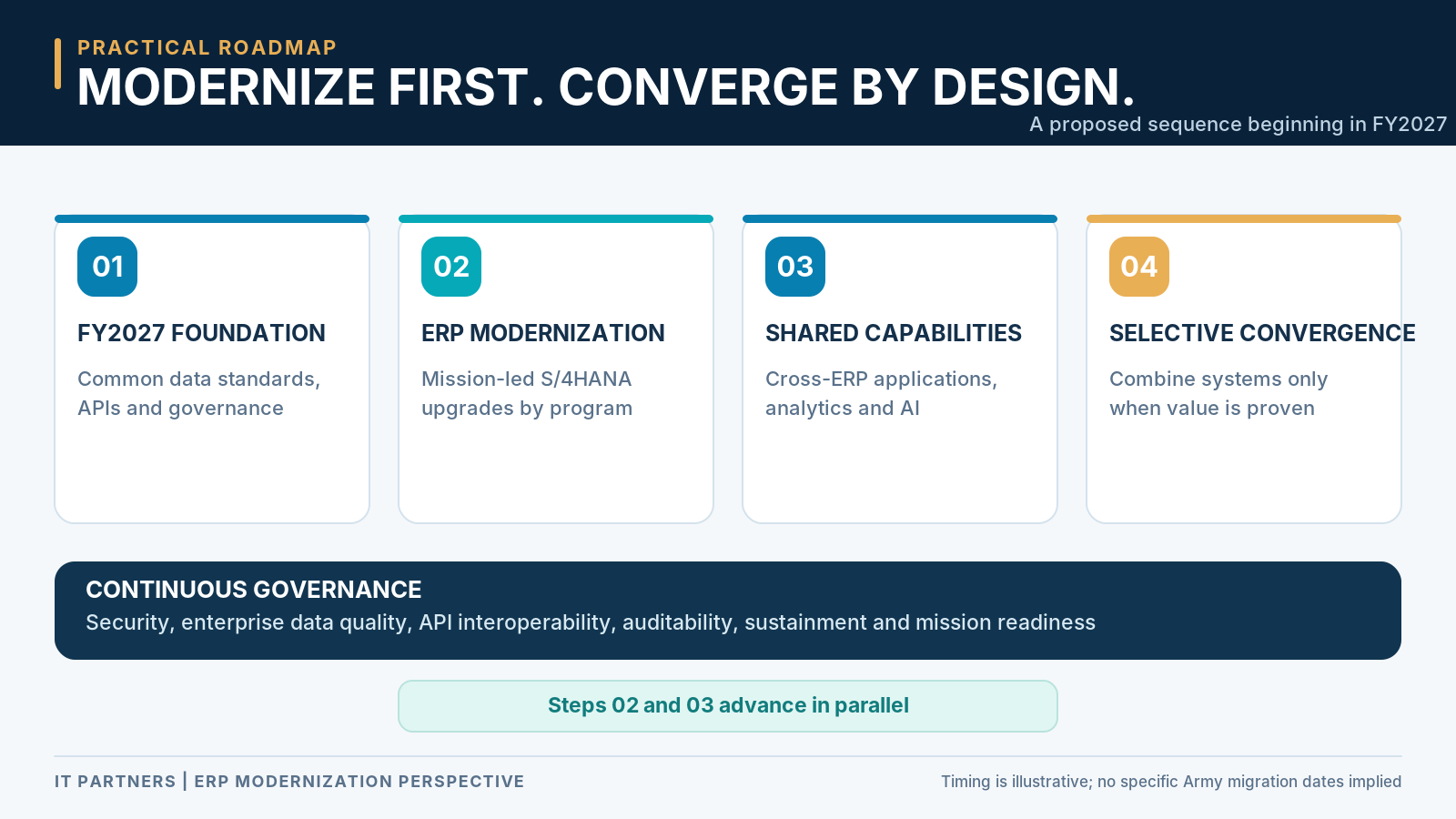
If I were King…LOL I would use FY2027 to establish the architectural foundation for this approach.
First, the Army should define a common enterprise target architecture covering the future SAP cores, enterprise data model, integration standards, application platforms, and shared sustainment services. This should be a government-owned architecture that individual programs and contractors can implement consistently.
Next, each ERP program should complete a modernization readiness assessment. That includes understanding its current technical condition, business processes, custom-code footprint, data quality, interfaces, and migration options.
The Army could then establish coordinated modernization roadmaps, with each program proceeding according to its mission requirements and operational risk.
In parallel, I would begin developing shared capabilities that deliver value before the S/4HANA conversions are complete. A common operational application, an integrated logistics workflow, or a cross-ERP analytics capability could demonstrate the benefits of the enterprise architecture while the existing SAP systems remain operational. This would allow the Army to deliver incremental improvements rather than requiring users to wait years for a consolidated replacement system.
I would also keep sustainment and modernization funding visible as separate priorities. Day-to-day operations must continue, but they cannot consume every available resource and prevent the technical modernization needed to reduce future sustainment costs.
Finally, the Army’s acquisition strategy should reflect this new architecture. Rather than relying on a single large systems integrator to manage the entire transformation, the Army could structure modernization around smaller, well-defined work packages with common integration standards, measurable outcomes, and clear government ownership.
This approach would also create meaningful opportunities for small businesses to participate as prime contractors, not simply as subcontractors to large integrators. Work involving SAP modernization, data harmonization, API development, application integration, automation, cybersecurity, and independent testing could be competed as discrete efforts. Many small businesses possess highly specialized expertise in these areas and can deliver innovative solutions without the overhead associated with large, enterprise-wide programs.
The objective should not be to exclude large systems integrators, but to create an acquisition environment where companies compete based on their capabilities and the value they deliver. By retaining ownership of the enterprise architecture and establishing open integration standards, the Army could introduce new technologies, replace underperforming contractors, and modernize individual capabilities without repeatedly renegotiating the entire enterprise solution.
Modernizing the Army’s ERP environment should also be an opportunity to modernize how the Army acquires technology, creating a more competitive marketplace where small businesses can play a meaningful role in delivering mission capabilities.
Summary
I don’t view the decision to stop the original EBS-C consolidation contract as the end of Army ERP modernization. I see an opportunity to rethink the sequence. The Army still needs modern SAP environments, simpler business processes, reliable enterprise data, better integration, and lower sustainment costs. Those objectives have not changed.
What can change is the way they are achieved. Modernizing the individual ERP systems first, while establishing common architectural standards and a shared application layer, could reduce the complexity of future consolidation and begin delivering enterprise-wide benefits much sooner.
The Palantir enterprise agreement creates additional opportunities to connect data, automate workflows, and introduce new capabilities without embedding every business requirement inside the SAP core. It will still require disciplined data governance, sound integration architecture, and careful coordination across the ERP programs. No single software platform eliminates that work. But the resulting architecture could give the Army something far more valuable than simply combining several legacy systems into one. It could provide a modern, interoperable enterprise in which transactional systems remain stable, applications evolve quickly, and information moves securely across mission boundaries. And when the time comes to consider consolidation, the Army could make that decision based on operational value rather than technical necessity.
Perhaps the real lesson from EBS-C is that the Army does not need to consolidate its ERP systems before it can operate as a unified enterprise.
It needs to design and modernize them so they can operate as one.
That is the difference between consolidating systems and achieving convergence.